Monday, February 24, 2020

Rise! From Caged Bird to Poet of the People, Maya Angelou by Bethany Hegedus & Illus by Tonya Engel


Maya Angelou--this woman was a rockstar! 
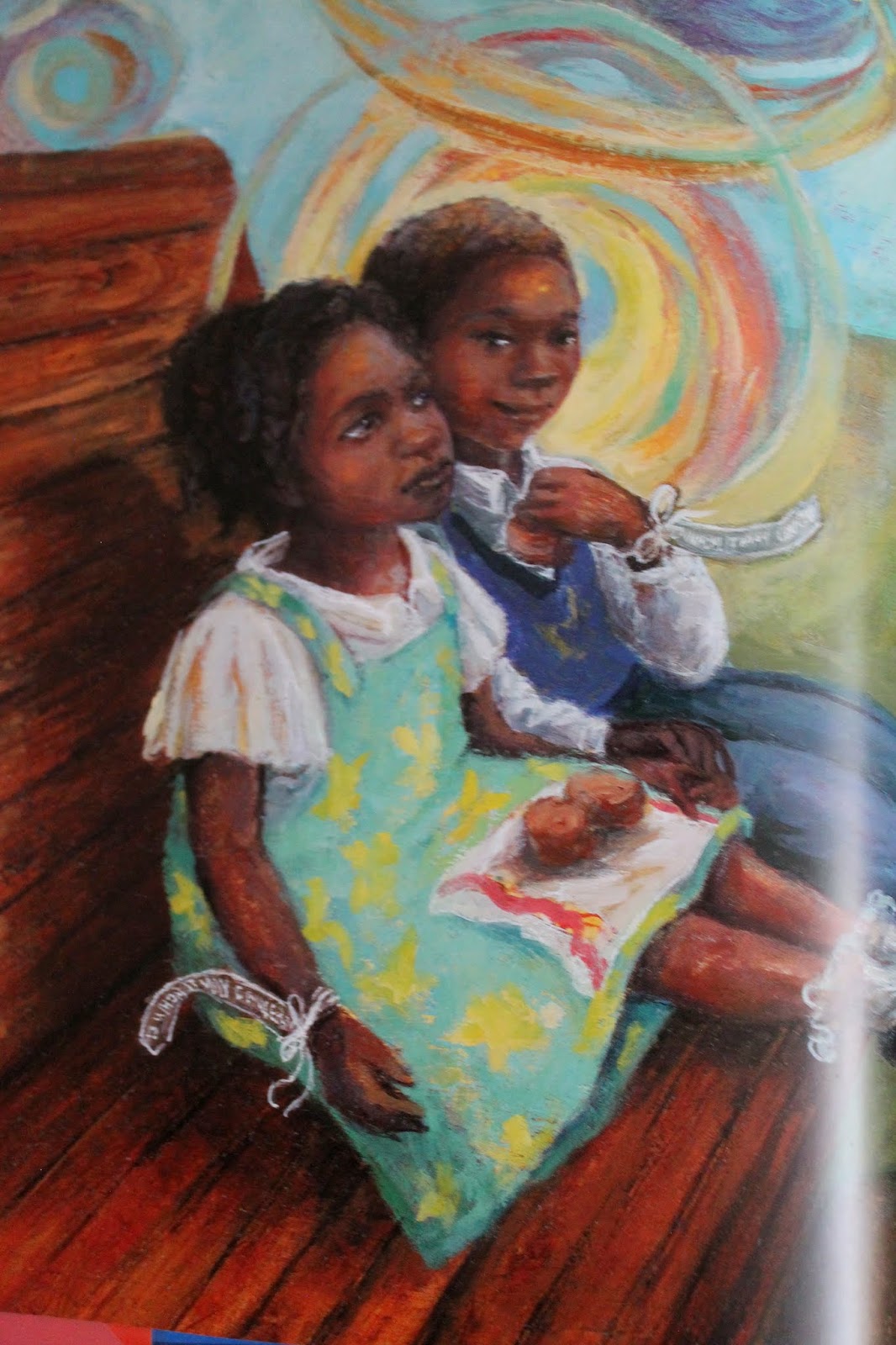

This book has colorful and swirling art. 

Maya and her brother going south to live with their grandma. 


Isn't this art amazing? 

Life was mostly good in Stamps, Arkansas. They were cared for and loved by their extended family. They also witnessed the cruelty of racial prejudice endemic in the south in the 1930s.


When their mother settled into a new relationship in Chicago, she sent for the children to visit. 


Of course, that relationship was fraught for Maya. I love how a children's book deals with such a heavy topic (childhood sexual abuse) in such a... well delicate but effective way. There are a lot of kids who feel this sort of fear in their own home and I can only imagine their relief at seeing that same experience reflected in a picture book. 

Still, I hesitate to read this to very young kids. I guess I feel like I need a little more training on how to handle student's comments and questions in a careful way. 


After she was assaulted, one of her uncles allegedly killed her attacker. As a young girl of seven, she felt her words had killed him, so stopped talking to anyone but her brother.  But she still loved words--the rhythm and cadence of words, the beauty and depth of words.


Outside, Maya is quiet. Inside, words make music. Maya memorizes the rhythm, sways to the exquisite dance, the twisting, turning, conga line of language. 

Poetic. 


Maya earned a scholarship to a San Francisco Labor College and studied dance and drama.  


As a young single mother, Maya struggled, but never gave up on her stage talents. Marrying a Greek sailor and aspiring musician at 24, she used a form of his last name for her stage name, Maya Angelou. She toured Europe with Porgy and Bess during the early 1950's. Eventually she went on to release an album of her own compositions and win Tony awards for her acting in multiple works. 


She was passionate about civil rights, working with Martin Luther King Jr, South African activist Vusumzi Make (who she fell in love with and moved to Cairo with), and then meeting and working with Malcolm X in Ghana. 


After MLK Jr.'s murder on her birthday, Maya was devastated, but her friend James Baldwin encouraged her to put that devastation to work and free herself by writing an autobiography. 

In 1970 I Know Why the Caged Bird Sings was published and became an immediate success. 

She went on to win Grammy's for her spoken word albums of poetry, had great commercial success as an author, became the first black women to write a produced screenplay, and became a professor at Wake-Salem University. 


Maya Angelou was an incredible, incredible woman. Massive intellect, charm, From a somewhat troubled beginning (broken family, sexual abuse, young single motherhood, a failed marriage) she went onward and upward, teaching at universities in Ghana and the USA, mastering six languages, and being a life long advocate for civil rights.


In 2011, she was awarded the Presidential Medal of Honor for a life of achievement. 

She was a dynamo! 

Monday, February 3, 2020

The Women Who Caught the Babies by Eloise Greenfield & Illus by Daniel Minter


Oh my word. This book is so gorgeous. 


It begins with a little historical note about African-American midwives. 


And then the amazing Eloise Greenfield launches into poetry illustrated eloquently by Daniel Minter. 

These pictures are not the greatest, so I strongly advise you to find a copy of this ASAP.


There is such a geometric/batik quality to the detail here that seems so timeless. 

And those biceps....!!


I don't pretend to fully understand all the art, but that might be what adds an element of awe to it. 


Greenfield writes poems throughout the centuries up until the present day, but doesn't overwhelm the reader with words or poems. Spare word use and only a poem or two a century, make the words stand out. 


Emancipation Proclamation--the first child born free. 


The early 2000's


Welcome them into the world for loving. 

Swoon. 

I don't feel this review really portrays the magnificence of this book (okay, it doesn't at all--I don't know what is wrong with my camera) but trust me on this--it is incredible. 

Wednesday, January 29, 2020

The Cabin Key by Gloria Rand & Illus by Ted Rand


Gloria and Ted Rand are an amazing husband/wife team. However, I think they sometimes write books for adults more than children. As a somewhat nerdy/serious kid, I loved them then and I love them now, but they are not books that are going to get kids worked up. They are quiet and generally somewhat nostalgic. And they tend to be wordy. 

This story is no different. Using memories of the Rand family cabin, the story follows a little girl and her experiences at the cabin through her childhood. 

Great story, but you need to know your audience. Are they thoughtful? Can they sit quietly for several paragraphs before another page turn/picture? 


It was a very snowy day when I was taking picture, which seemed  fitting. 


I even had a snowy pinecone. 


Ted Rand does such brilliant landscape/nature scenes. 


The little girl is entrusted with unlocking the door, which is a huge honor. 


Aren't these pictures great? 


Carrying in the wood


Love, love, love this picture! 


The joys of enamelware.


Listening to stories and watching the flames.


Coziness. Doesn't that blanket look realistic?! 

Also, the next picture (that I didn't get a picture of) shows the little mice scurrying around, so not cozy and no sleep for me. 

The family cabin is all very well and good, but mice ruin all the warm fuzzys. My husband's family has a family cabin in the Rocky Mountains. One time we took my cousin and his wife for a weekend and didn't bring quite enough bedding, so we gave them the sleeping bags and ended up using the sheets/blankets that were already on the bed. It was dark when we went to sleep and I just thought there was sand in the sheets, but.... in the morning, I saw it wasn't sand. It was mouse dirt. 

I still love the cabin, but I don't plan on forgetting sleeping bags ever again. 

Wednesday, January 22, 2020

Snowed In by Barbara M. Lucas & Illus by Catherine Stock


This past weekend we were rather snowed in--not for months on end, but for a full 36 hours, which felt dramatic enough. 


This is the story of Grace and Luke. At first you think they are just waving goodbye like a regular day. 


But then they go to the store and pick up a lot of supplies. 


And they get boxes filled with books from the library. 


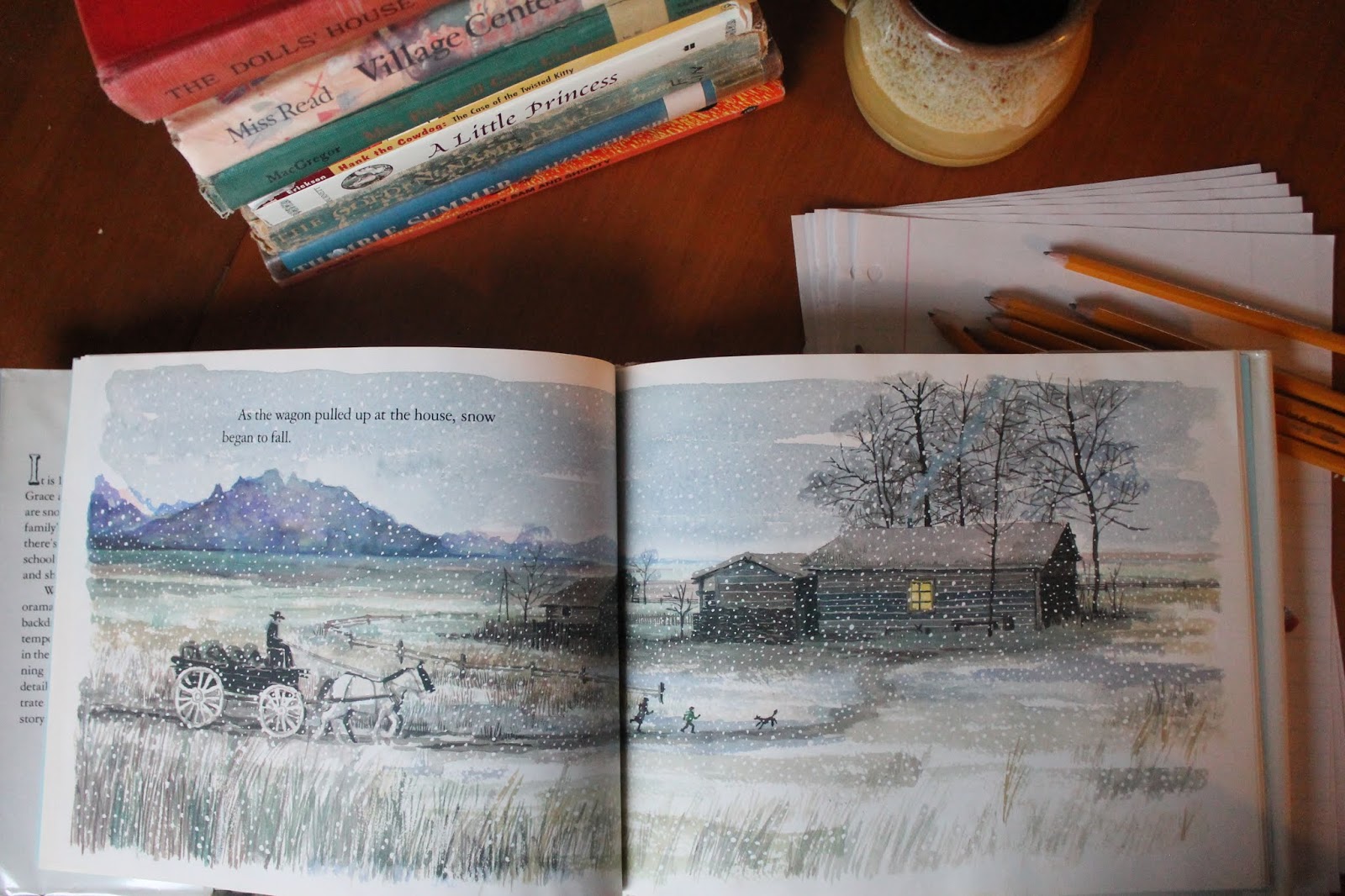
Snow is just beginning to fall as they reach home. 


By the next morning, they are snowed in for the rest of the winter. 

As a child, that sounded enchanting. As an adult, it sounds a little petrifying. I like staying at home as much as the next person, but.... I can leave when I want. I can imagine feeling a little boxed in if I couldn't leave. 


They do their chores. 

And read. 


I have always had a bit of a love affair with the west, so a book combining the west and a love of reading is going to win me over pretty easily. 


Apparently this story came from a cowboy Barbara Lucas talked to once--he showed her some of his own writings and they talked about his schooling, since his writing showed an incredible depth of literary knowledge and intelligence. He said he got to school when he could, but was often snowed in for the winters, so his parents always made sure there were a lot of books around. 


Aren't these pictures great? 


Imaginary wanderings.

Heart eyes!


And then it was spring again and the way to town thawed out. 

As long as the supplies held out, no one got incredibly sick, the house didn't burn, and no wolves/bears/murderers came to call, I could see this being an idyllic time. 

Basically, I would like to be a pioneer, but with no inconveniences. Sounds reasonable. 

Monday, January 20, 2020

A Place to Land by Barry Wittenstein & Illus by Jerry Pinkney


Another MLK Jr. book? Yes, please! This was one of those books I wasn't sure about on the first read through. It seemed to be a non-story in some ways. It tells the back story on the famous "I have a dream speech" which is basically, Martin went off script.

But the more I read it, the more nuanced it is. There is still so much to say and learn about this man, the things he did, and the words he said. 


Pinkney is no slouch--this is before the title page, which is often left blank, but not here. 


The night before the speech, Martin didn't know what to say. 

So Martin did what great men do. 
He asked for guidance. 
Not from above.
At least not at first. 

They all had their say, including an adviser saying he had used the "I have a dream" line too often and it could not be used effectively again. 

Part of Martin's greatness--he knew 
the importance of listening. 

I love these two excerpts that show the humility of truly great men. 


After listening, he went upstairs and thought about all the people who went before him in this fight and what they would want him to say. 


Detailed view.

Seriously, Pinkney puts so much in each picture--textured and layered. 


Martin wrote late into the night. 

Words crossed out three, four times, searching for the perfect meaning and rhythm. 

Even Martin, as brilliant as he was, edited and rewrote.

I love the collage elements over in the left hand corner here. 


The next morning, people came from all over the country to Washington--to be met with soldiers in riot gear. 

Map collages are never not a wonderful addition. 


Even an hour before he was supposed to speak, Martin kept thinking about what to say, things did not feel totally settled. He hadn't found his place to land yet. 


Martin began his speech and then, paused. He wasn't feeling inspired, so his audience wasn't either. 

Mahalia Jackson, the "Queen of Gospel," told him to tell the people about the dream.


And then came some of the most inspiring words America had heard in years. 


Afterward, people joined hands and sang, "We shall overcome."


And Martin went to the White House to shake hands with JFK who had been slow to embrace the civil rights movement and tried to convince its leaders to cancel the march. 

Students are often surprised that a president would work against Martin Luther King Jr. How could any right thinking person disagree with him? Some great conversations about that. 


Martin stepped up to the lectern, 
and stepped down on the other side of history. 

And then the ones who came after.


Mini-biographies of the people pictured advising Martin.