Showing posts with label New York State. Show all posts

Monday, March 12, 2018

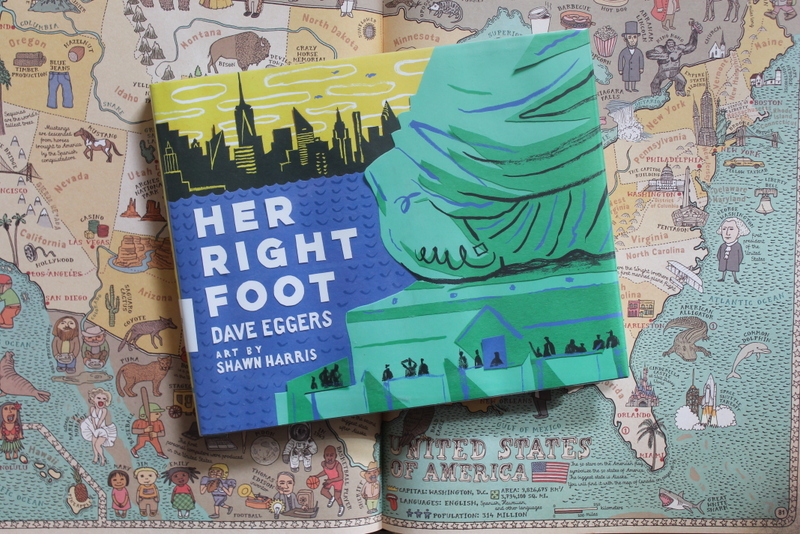
Her Right Foot by Dave Eggers


To be honest, I thought this was a story about the Statue of Liberty walking across America. Which I think I have seen before. And that would be a little weird. Because the Statue of Liberty walking around is a whole lot concerning. I mean how many people is she crushing under those Grecian sandals? 

No thank you. 

But, good news! This is not that book. I am not sure if it ever was a book or just a nightmare I had once after eating something too rich before bed. 


And it probably is really lovely. 
(Sorry, other author person.)


Anyway, this book is back story of the Statue of Liberty, with a focus on her right foot. 


The story starts in France. With two crazy men. I can't quite understand why they are so crazy in this picture.  


Giant hand and arm


But we just put it together! the workers said. 
That is absurd, they said.
They said all this in French, 
the language of the French,
a people who appreciate the absurd. 


Made out of copper, the statue was originally brown. Over time, it changed to green. 


I love this picture!


Eggers draws everyone's attention to the forward motion of the actual statue. The right foot is raised as though mid-stride. 


Liberty and freedom from oppression are not htings
you get or grant by standing around like some kind
of statue. No! These are things that require action. 
Courage. An unwillingness to rest. 

So of course the Statue of Liberty couldn't stand around being all static. 


The many way people arrived in America


The immigrants.

Friday, April 8, 2016

From the Mixed-up Files of Mrs. Basil E Frankweiler E. L. Konigsburg


Having won the Newbery in 1968 and being a favorite with middle school English teachers, I am going to assume that everyone knows this book. The kids and I just listened to the audio book a few weeks ago and we all loved it. Last night, seeing the book laying by the computer, they decided to start it all over. 

It is that good. 


A large part of the appeal is the lack of adult supervision in this book. Somehow, Claudia and her younger brother Jamie, runaway to New York City together. They bring their instrument cases and bookbags packed with clothes and necessities. Claudia has planned out their runaway to a T. This picture is her mailing a letter to her parents that they are fine and not to worry. Claudia, although she is set on running away, does love her family. She just wants to be taken more seriously. 


Claudia's brilliant plan is to hide out in the Metropolitan Museum of Art. Completely brilliant. As a child, I always used to wonder what public spaces were like after the doors were locked and everyone went away. The Mixed Up Files is the ultimate child's fantasy. Well, real world based fantasy. Here, Claudia and Jamie choose which massive, antique bed they should sleep on. Surprisingly, these sumptuous seeming beds are completely uncomfortable. 


The floor plan of the Met. Claudia has planned everything pretty well. When they get there, they enter and check their bags as they are supposed to. After scoping out the place for a few hours, they get their bags from the clerk and leave. In a little while, they enter again, claim they are on their way home from school and are meeting their mother in the children's museum on the other side, they convince the watchman to let them carry their book bags and instruments through the museum. Having planned on where to stash their bags already, they go ahead and stash their bags behind fabulously expensive displays. 

Another part of the appeal is their familiarity to these fabulous object d'art that other people come from all over the world to see. To Claudia and James, these fabulous pieces become their background. 


To trick the guards, they head to the bathrooms about ten minutes before closing. Then comes a long half hour of waiting, crouched down upon a toilet behind a partially closed bathroom stall door. After the doors are locked, the guards do a thorough (but not thorough enough) walk through of the museum and leave for the night. 

The museum is now Claudia and Jamie's. 


Inevitably, they become drawn into a mystery about a new display--a small angel. Was it or was it not sculpted by a young Michelangelo? They head to the public library to look a few things up. Being kids, they imagine themselves able to look at a few books about Michelangelo and a few books on determining the authenticity of art and suddenly know who sculpted the angel. 

Claudia is bitterly disappointed by her lack of sudden certainty about the angel. Jamie, who had to look through all the books with pictures, has a lovely and informative time. 


After a few days, the need to bathe becomes paramount. They have no option, but to bathe in the fountain in front of the museum restaurant. While bathing, they discover a new source of income for their dwindling fortunes--scooping up money from the bottom of the fountain. 


To pass the time and remain inconspicuous, they attach themselves to the tail end of groups of kids on school field trips.


Discovering a faint mark on the angel, Claudia and Jamie are certain they have solved the mystery, but when they write to the museum (and rent a PO box so they can receive a reply) the museum tells them they know about the mark, and even thought it is Michelangelo's mark, some artists marked all their stone, some of which they gave to other people to use. 

Claudia and Jamie are crushed by this. Finally, they decide their great adventure must come to an end. But Claudia has become so wrapped up in discovering the truth about the angel that she simply must visit Mrs. Basil E Frankweiler, the person who donated the angel, before they head home. Although a recluse, Mrs. Frankweiler chooses to see them. After discussion, Mrs. Basil E Frankweiler decides she will trade with them. Their entire tale of running away to the Met for the chance of them rummaging through her mixed up files for an hour to find the truth about the angel. With only minutes left, they find what they are looking for. And then Claudia discovers why Mrs. Basil E. Frankweiler has not made public the proof she has of the artist--a secret like that is worth much more than setting everyone's mind at rest. 

Secure in  her knowledge, Claudia feels she has changed enough to go home. 

She is a little confused as to why her parents are so anxious about her and Jamie getting home, though. Didn't she send them a note telling them not to worry?  
Wednesday, February 3, 2016

Ice Palace by Deborah Belumenthal and Ted Rand


This is a marvelous book, I love Ted Rand's illustrations, I love the Saranac Ice Palace, and I love the fact that this is only 45 minutes away. It makes us feel special. There aren't too many books about Northern New York.

And, this book is a good story. Well written and fascinating. Local books can be a little... well, poorly constructed. But this one is super.


Aren't these fun pictures? The Ice Palace is built to kick off the Saranac Winter Carnival. Since the carnival starts this weekend, I have been seeing picture of it's construction on facebook. Winter Carnivals are pretty much something thought up by town leaders of northern areas to keep people from going crazy with cabin fever. There are several in Northern New York. We are all on the verge of going crazy in February. 


Isn't this a great picture? 


Once the ice is a certain thickness, it is marked into a grid and cut into whatever size squares they need to build this year's ice palace. 


Originally, a minimum security prison in the area, Camp Gabriels provided the labor for construction. In this story, the little girl has an uncle in Camp Gabriels for a year. He is chosen to help with the Ice Palace, which makes the little girl proud. Really, it was a good system. Building the palace made the men feel proud and like they were contributing to society and they actually were contributing. 

During the budget cuts of 2008 or 2009, Camp Gabriels was closed. So the prisoners no longer help build the ice palace. I am not sure exactly who does, but I think a local union is building it this year and is eager for any and all volunteers. 


The prisoner's leaving at the end of the day.


The Carnival Royalty


A different theme is picked for each year. The book has a circus theme or some such. It doesn't actually say. This year's is Villans & Heros. 


Fireworks


Love this picture of her sitting, talking to her Dad all about it. 


And I love the idea of this service to the community making the prisoners better men. Walking a little straighter. 

Wednesday, January 20, 2016

A Farmer Boy Birthday by Laura Ingalls Wilder illustrated by Jody Wheeler

Have you seen these books? They are picture books of various episodes in the Laura Ingalls Wilder books. For quite awhile, I wasn't too interested in them. How could you improve on Laura's writing and how could Almanzo or Laura be Almanzo or Laura if they weren't in Garth Williams illustrations? 


After someone bought my kids one though, I had to admit that they were quite pleasant little books. My kids are fascinated with Laura and Almanzo and have listened to the audio books (read by Cherry Jones) a thousand or so times. The older two (9 & 8) aren't that interested in these books anymore, but Gilbert, 6, and Elsie, 3 like these ones. They are definitely geared toward little kids. 


Almanzo is our hometown boy. Probably the most famous person to grow up in Northern New York. I bought this book at the Wilder farm in Burke, actually. 


The pictures are rather sweet, based on Garth Williams illustrations. 

(Geraniums on the windowsill means they are my sort of people.)


This book, obviously, is about Almanzo's birthday. Because it was his birthday, he didn't have to go to school. 

I like their style. 


Almanzo spends the morning training his two little oxen, Star and Bright, to the new yoke his father gave him. 


Almanzo knew he was growing up because his father let him do the oxen training by himself. 


And after lunch, he had a new sled. 


Of course, there is a lot of food. Jars of doughnuts and cookies and some apples. 


Helping his dad.


All in all, it is a sweet book. 

A book to get kids interested in Laura Ingalls Wilder before they are old enough for the real deal. 

Monday, January 4, 2016

Snowy Day By Ezra Jack Keats

For some reason, growing up in the eighties, I felt that this book was way overexposed. Librarians read it to us, teachers read it to us, it was printed in our textbooks--it was just too much. So I decided I didn't like it. I carried this childish prejudice along into adulthood, until it was smashed to smithereens by actually picking up a copy of it, acquired at a library book sale sometime, and reading it. I fell in love with it.

The pictures! (The same pictures I was so bored with in first grade.) I love them now. 

The story! Growing up in the north, I can recognize and relate to every feeling Peter has. To wake up to the changed light that means the world is snow covered and just unrecognizable enough to seem completely separate from the everyday world you woke up to yesterday. And the urge to go exploring--I still feel like that when it snows.    


This book was a big deal. The winner of the 1963 Caldecott, it was the first book to feature an African-American in a full color children's book. 


Keats says "I wanted to convey the joy of being a little boy alive on a certain kind of day--of being for that moment. The air is cold, you touch the snow, aware of the things to which all children are so open."


Friends, snowflakes, giant snowdrifts.


I love Peter sitting in this bath and thinking. And thinking. 


The snowy footprints, Peter's darling little red suit with a gnome hat.
I adore this picture.