Showing posts with label History. Show all posts

Monday, August 26, 2019

Out of the Woods by Rebecca Bond


A story about a wildfire in Northern Ontario. 

A story about creatures, both human and animals, coming together in their common fear.


Lovely illustrations!


Antonio Willie Giroux (a great name if ever there was one) lived with his mother who ran a boarding house on the edge of a lake in rural Ontario. 


It was a pretty great life for a kid--so much to see, so many people to dote on him and teach him how to do things. 


The second floor was full of sportsmen come to do some hunting and fishing. 


The top floor was filled with the French Canadians working in the nearby timber harvesting outfits. Willie loved spending time up there listening to words in French, English, and several different Native American languages. 


One summer day, smoke came out of the woods and threatened their lives. 


As the fire edged closer, people crowded into the lake for safety. 


And as it got even closer, wild animals fled from the woods into the lake with the humans. 


And they all stood together, uncommon companions, watching the fire rage by them. Somehow in their common fear, predators did not attack prey, but somehow understood that this situation was beyond the realm of their conventional relationship. 


By some miracle, the hotel did not burn down. So they crept back after the fire, remembering the moment they stood shoulder to haunch with the wild things of the forest. 

Thursday, July 18, 2019

Turtle in Paradise and Full of Beans by Jennifer L. Holm


Rather cluelessly, I read Full of Beans before I read Turtle in Paradise. Which is interesting. Because Full of Beans takes place just BEFORE Turtle in Paradise, but was written AFTER. 

So I feel like I read it backwards even though technically I read it chronologically. 

First of all, both are great historical fiction books set in Key West during the Great Depression. This was just before Key West became a tourist destination, so there is certainly some gritty reality in them. 

(Also, avocados are called alligator pears. I enjoyed this detail for no real reason.)

Turtle in Paradise deals with a girl named Turtle who is sent off to live with relatives in Key West because her mother took a job as a live in housekeeper to someone who won't have kids around. In Key West, Turtle gets to know her family and finds adventure. 

Full of Beans gives us a backstory for Turtle's cousin Beans. I know Turtle in Paradise won a Newbery Honor, but I definitely liked Full of Beans more. Beans is an opportunistic realist, which makes him a fascinating character. He is an entrepreneur where there are no jobs and hardly any money. But somehow, Beans figures out a way to make a few bucks. Not surprisingly, Beans has a few moments of moral quandary or two as he makes money doing odd jobs that are not always strictly legal. If no one is hurt, does it matter? A question for the ages.

I liked Turtle, but Beans captured my heart. 

Monday, April 15, 2019

My Village Sturbridge by Gary Bowen


This is an interesting book. When I first saw it, I assumed it was a non-fiction. I mean, wood engravings and details about old New England villages? 


But it was made as a work portfolio a young fictional engraver would have sent to a prospective employer. 


So it is fiction, but full of historical detail.

And cool wood engravings.


Parlor


...a supplier of the unusual. Silks, ivory, combs, coin-silver spoons, and even my writing quills.


As a bit of history nerd, I enjoy this book. 

Pretty sure it would be a hard sell to any non-history nerd.  


A stenciled floor and a granite fireplace


Sheep! 


Maple tapping!!

Mostly I like this book because it has sheep and maple tapping. My high editorial standards. 

Monday, December 17, 2018

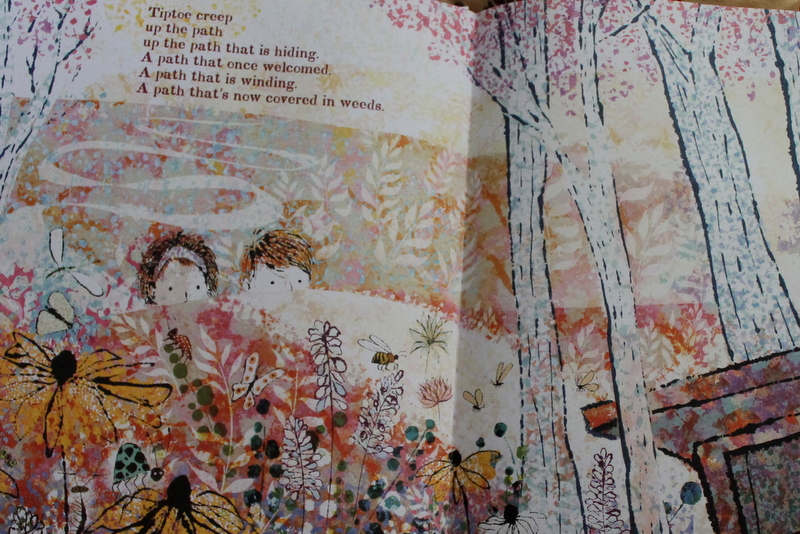
A House that Once Was by Julie Fogliano & Illus by Lane Smith


This book... I have seen it on several potential 2019 Caledecott lists. Which doesn't mean a whole lot to me, since several Caldecott books leave me cold. But then, I am not an artist, so I don't totally understand the progressive techniques illustrators might be using. However, being a potential Caldecott winner proves that the art is pretty snazzy. 

And the words? Oh my. 

Deep in the woods
 is a house
just a house
that once was
but now isn't
a home.

First read through, I tripped and tumbled over several words. My brain has certain expectations of the next word--like the predictive text feature on a smartphone. So my brain is jumping ahead at a fast clip and before the first page was done, I realized I needed to slow down or I would mangle the story. 

HOW CAN AN AUTHOR CONTROL HOW FAST I READ?

But somehow, Julie Fogliano does it. This is a slow and savoring read. 

(Having just sold a house we lived in for 9 years, a house that saw two new babies, a lot of growing up, and a lot of living, this book seemed perfect. A house that once was, but now isn't a home. I had a hard time letting go of our sweet little house. We wanted more land, but we loved that house. I full on sobbed, just thinking about seeing the house empty, without us. Seeing our house lonely. But somehow, when I walked into the empty house to do a quick check before the buyer's final walk through, it was just a house, it wasn't our home anymore. And I loved it for what it gave us, but I can let it go. Because it is a house that once was.) 

So this book? It might just be a timing thing, but it hit me pretty deep. 


Tiptoe creep 
up the path
up the path that is hiding
A path that once welcomed
A path that is winding
A path that is now covered in weeds. 

The last Julie Fogliano book that I loved was When Green Becomes Tomato, a book of poetry. So it should come as no surprise that the text here is lyrical and poetic. 


These two exploring friends find an abandoned house in the woods. A house that once was, but not isn't, a home. 

 Inside the house            
 it is silent but creaking. 
 We're whispering mostly
 but not really speaking. 
                                            We whisper though no one would mind if we didn't.
       The someone who once was
is someone who isn't.   
       The someone who once was
is gone.                        

The children look around the house and try to imagine the people who once lived in the house. 


 Who was this someone   
           who walked down this hallway
    who cooked in this kitchen
   who napped in this chair?
Who was this someone   
  who left without packing 
someone who's gone      
but is still everywhere?  

Was it someone with a big beard and glasses who would look out the window and dream of the sea?


Was it someone who liked to paint squirrels in the garden?


Or a girl who liked to dance and sing to records?


Where did they go? 

Or what if they're lost and they're wandering lonely? Maybe they can't find their set of house keys?


Does the house miss these people? Does it wish it were filled up with noise and with laughter? Is it lonely?

  Or maybe is loves to just sit and remember
Stories of someone who we'll never know
  And maybe it likes it out there in the forest
              with the trees coming in where the roof used to go.


And after their adventuring, our two explorers head home to their house that is very much a home.