Showing posts with label Native Americans. Show all posts

Monday, July 29, 2019

The Gift by Kristine L. Franklin & Illus Barbara Lavallee


Barbara Lavallee is an Alaskan artist that my mother fell in love with when I was a kid. We had prints of hers on our wall, trivets with her art, the mugs with her art were set in a separate place so my brothers and father wouldn't fill them with coffee and take them to some far flung part of the farm and leave them on fenceposts, under a tractor seat, or in the milkhouse. 

As a hangover from my childhood, anything Barbara Lavallee has illustrated has instantly become a bit special. I found this book on a library shelf in Anchorage last summer and had to check it out. With a 50 book limit* on our library card, we had to make some hard decisions about what we were and were not taking home with us, but this made the cut. 

(This may seem like a gigantic limit, but it had to supply four kids, as well as myself, so it actually was a little hard. Books had to be put back on the shelf and left behind, always a sad, sad thing.)


I was already in favor of the illustrator, but the story itself was well worth it as well--traditional native fishing villiage, elder wisdom, and amazement at nature. 


Jimmy Joe loved to fish, just like all the rest of his family. 


So Jimmy Joe heads over to "help" the fish woman catch some fish. They get everything ready to head out to fish. 


My cousin worked in a gift shop in Anchorage one summer and hated Barbara Lavallee due to the dividing line down the middle of the faces. Having been raised on these prints and illustrations, I never thought about it before. But there it is. In every face. 


Fish Woman has promised Jimmy Joe a salmon fishing expedition. Salmon in their richness and bounty hold a special place in the lives and imaginations of the native peoples of the Pacific Northwest/Alaska. Jimmy Joe is determined to catch the best, the biggest, and the most. 


Catching the fish and putting it on ice.


When he catches a fish and sees all its sparkling majesty snuffed out, Jimmy Joe is torn. He knows his mother wanted fish to eat, but how can he take this beautiful thing from the sea? 


Then!--the magic! The wolves of the sea appear. 


Deigning to show themselves is a gift from the sea. The wise Fish Woman and Jimmy Joe both recognize the honor. 


And suddenly, Jimmy Joe knows what to do with the magnificent fish he caught--return it as a gift to the orcas. 


This is a little confusing since he was hesitant to catch the fish and use it to feed his own family, but I guess being the meal of an orca is a bit more fascinating to a little boy than being the meal of a mere human. 


And he heads home--salmonless, but with an amazement and wonder of the sea. 

I like the practicality of this book--Jimmy Joe, while lamenting the necessity of killing such an amazing creature, also understands enough of nature to know the salmon can't escape being someone's meal. 

I love the Fish Woman helping him come to that realization. I like Jimmy Joe being allowed to spend time with (and wanting to spend time with) this elderly person who has so much wisdom and understanding to share with him. 

Monday, February 18, 2019

Alaska Boots for Chelsea by Phyllis Adams & Illus by Kathleen Lynch


Another Alaska book! 

Hopefully you don't get tired of Alaska books because, I have every intention of blogging about each and every Alaskan book that catches my attention. #noshame

This book is a tender look at personal responsibility, forgiveness, and renewal with a few traditional customs of the Athabaskan people thrown in. Or it looks at the traditional customs of the Athabaskan people with a side order of personal responsibility, forgiveness, and renewal. Depends on your perspective.


Chelsea is finally old enough for her very own pair of boots. Her sitsu (grandmother) tells her how to care for the boots as she makes them. 

"...they will be forever warm and light if you do not get them wet. Once they are wet, they become very heavy. You will feel like a Raven without wings. You can't fly, you can't dance."


These boots are made from the animals that are vital to traditional Athabaskan life--moose skin, caribou skin, and beaver fur. 

That is one thing I love about traditional customs--they tie people to the land so closely. Someone related to them likely shot, processed the meat, skinned the skin, and tanned the hide of these animals so they could be used. It is so much more intimate than mass commercial production. Of course it is also less productive and efficient. Trade offs! 


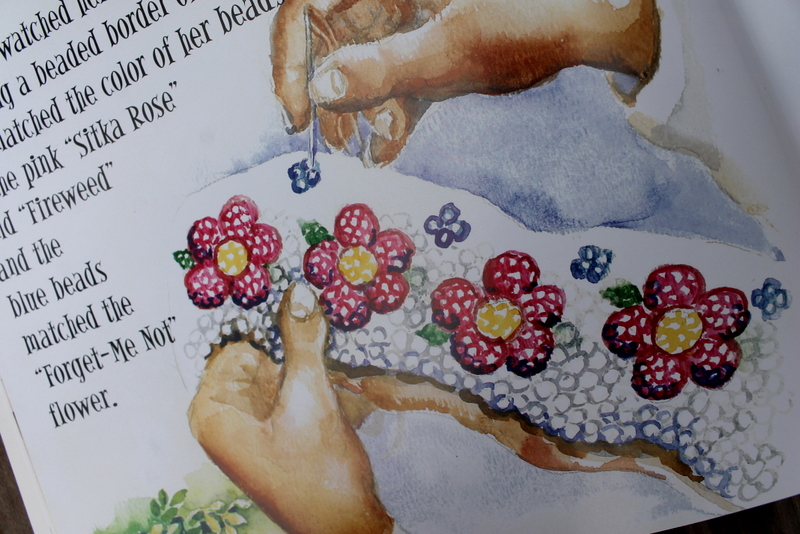
Beadwork decorations of Sitka rose and forget-me-nots.


And so Chelsea has her marvelous boots! And they keep her warm and make her dance all winter. 


But when the boots get wet in the spring, Chelsea throws them in a cache to hopefully let them dry out before anyone sees that they are wet. Except little creatures find her boots before Chelsea remembers to come back to get them.


When winter came again....


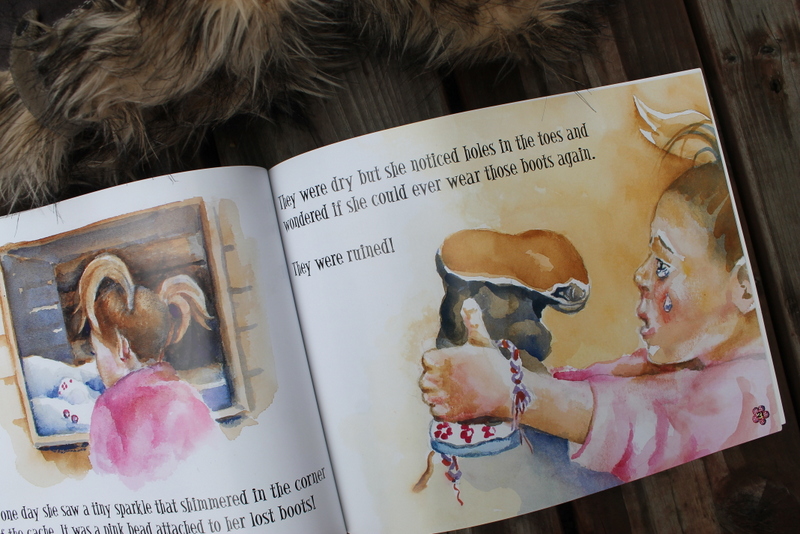
Chelsea went to find her boots. And instead of the beautiful boots her grandmother had made, she found damaged and ruined boots.


When she confesses all to Sitsu, Sitsu hugs her and tells her she can repair them. 


They are ready for dancing again for the potlatch.


And for watching the aurora borealis. 


At the back, there is a brief note from the author about Athabaskan traditions Chelsea experiences in the book and a glossary for terms. 

Wednesday, November 21, 2018

Chester Nez and the Unbreakable Code by Joseph Bruchac & Illus Liz Amini-Holmes


Today is Native American Day. At least where we live in Northern New York, which is right next to the Awkwesasne Mohawk Reservation. (Or more commonly reffered to as "the rez.") I thought this was an everywhere kind of holiday, but when I looked it up, it isn't any kind of official thing. 

But it should be.

So here is a story about a remarkable man who happens to be Native American.


Betoli was only eight when he was sent to the residential schools. To be taught to act like a white man. And in the process, he was given a white man's name--Chester.


Life was not easy in the residential schools, as I am sure everyone is aware. All the things held precious by the Native Americans were stripped away, ridiculed, and forbidden. 


Even their language, such an elemental tool was wrong. According to the people who ran these schools anyway.

The Navajo language was forbidden. Speaking it was a punishable offense. 


But during the summers, Chester was able to go back to the Navajo lands and remember the things that made his people who they were. 


I love this page, showing Chester in the two different worlds. 


During WWII, the government needed a new code. Every other code had been broken and utilized by the enemies. 

The government decided the Navajo language might just be what they needed. Chester and his friends were called up. 


The government suddenly needed the language it had been trying to beat out of these Native American children and teens. 

The Navajo codetalkers, chose an English word for each letter of the alphabet. A for ant, etc then translated those words into Navajo. The code word for the letter "A" became Wol-la-chee. Which had no bearing on the common languages the enemies would have access to when trying to decode the message. 


In addition to creating the code, Navajo speakers were needed for decoding it on the front lines as well. 


While not actively engaged in fighting, the code talkers witnessed the horrible atrocities of war. 

Chester survived.


When he returned home, they did an enemy way ceremony to help him to relearn and recover the trail of beauty and the Right Way. 


The Navajo code had done much to help the Allied war efforts and played a role in winning WWII. 


Even though the Navajo Codetalkers were so vital to the war efforts, their work and their code were kept classified for over 20 years. 

Fortunately for him, Chester did not let it bother him. He became a painter. 

In 2005, sixty years after the end of WWII, Chester was one of five code talkers who received the Congressional Gold Medal.

Monday, July 16, 2018

My Heart Fills with Happiness by Monique Gray Smith & Illus by Julie Flett


This book was sitting at our school bookfair, in among all the Shopkins, unicorn journals, and Disney character easy readers. 

I am not generally a huge fan of Scholastic bookfairs. BUT. This book. 


The dedication immediately piqued my interest. 

This book is dedicated to the former Indian Residential School students and their families--may you find what you seek...

Indian Residential Schools always interest me--such a devastating part of American history that is so under the radar. 


This book is full of reasons our hearts fill with happiness. 

The illustrations by Julie Flett are gorgeous. I love that they feature Native people. 


This page right here sold me on the whole book. Heart eyes! 


oh the delight


Love, love, love!


Grandmothers are the best


And at the end, we get a chance to think about what makes us happiest. 


A narwhal mommy and baby and a grandfather and grandbaby. 

Tuesday, September 19, 2017

The Absolutely True Diary of a Part-Time Indian by Sherman Alexie & Illus by Ellen Forney


This is a book I have heard about for years, but didn't read. I was in a cozy read rut for several years and didn't think this would be a cozy read. Of course, it isn't. But it is so good. And for all the terrible things that happen and the difficulty of Junior's life, it is chockablock full of hope. 

(chockablock is such a useful term. I resolve to use it more frequently in life.)

Have you read this book? You should read it now if you haven't. Most everyone should read this book. It is a frequently challenged book because it is a very honest portrayal of being a teen aged boy--not the most PC and G rated species on the planet. But if don't let that bother you, SO GOOD. 


There are quite a few cartoon pictures. After all, Junior, the main character, is a cartoon artist. Ellen Forney hits all the right notes with her renderings of "Junior's" work. 


Junior's sister, Mary Runs Away


There is a lot of anger and horribleness in this book. But Junior refuses to yield to the darkness of life. He lives around the horribleness and somehow manages to keep hope alive when all the world (or at least the world around his Spokane, WA area Indian Reservation) did their level best to drown hope at its very outset. 


This is so well written. I mean, it is Sherman Alexie, so duh. Of course it is well written. But Junior is so real, so vivid. Probably because a lot of this book is auto-biographical for Alexie. 

Junior's struggle between seeking a better life and leaving the reservation is raw and funny at the same time. He has a clear understanding of what life would be like if he stayed on the reservation and also an understanding of what a complete betrayal it would be to his family, friends, and tribe  to leave the reservation. How to reconcile those two things? 

Oh the angst of being a teenager! The beginning of the individual vs. the collective--making choices that are about you and not for others.


Fisticuffs! So much humor mixed into the anguish and pain of life in this book. So well done! The humor is a little like Junior's coping mechanism. And you laugh even while you are hurting for all the hopelessness of reservation life. 


Junior's Grandmother wears basketball sneakers "because she's got mad skills."


I like how the drawings vacillate between cartoon and more intricate drawings. 


I feel ya, Junior, I feel ya. Being poor never really bothered me as a kid. But it was something you would rather people not know about you. Just.... because. 


As a teacher, I often think about this--the struggle student's have in even being awake, clothed, and present at school.