Showing posts with label pioneers. Show all posts

Wednesday, January 22, 2020

Snowed In by Barbara M. Lucas & Illus by Catherine Stock


This past weekend we were rather snowed in--not for months on end, but for a full 36 hours, which felt dramatic enough. 


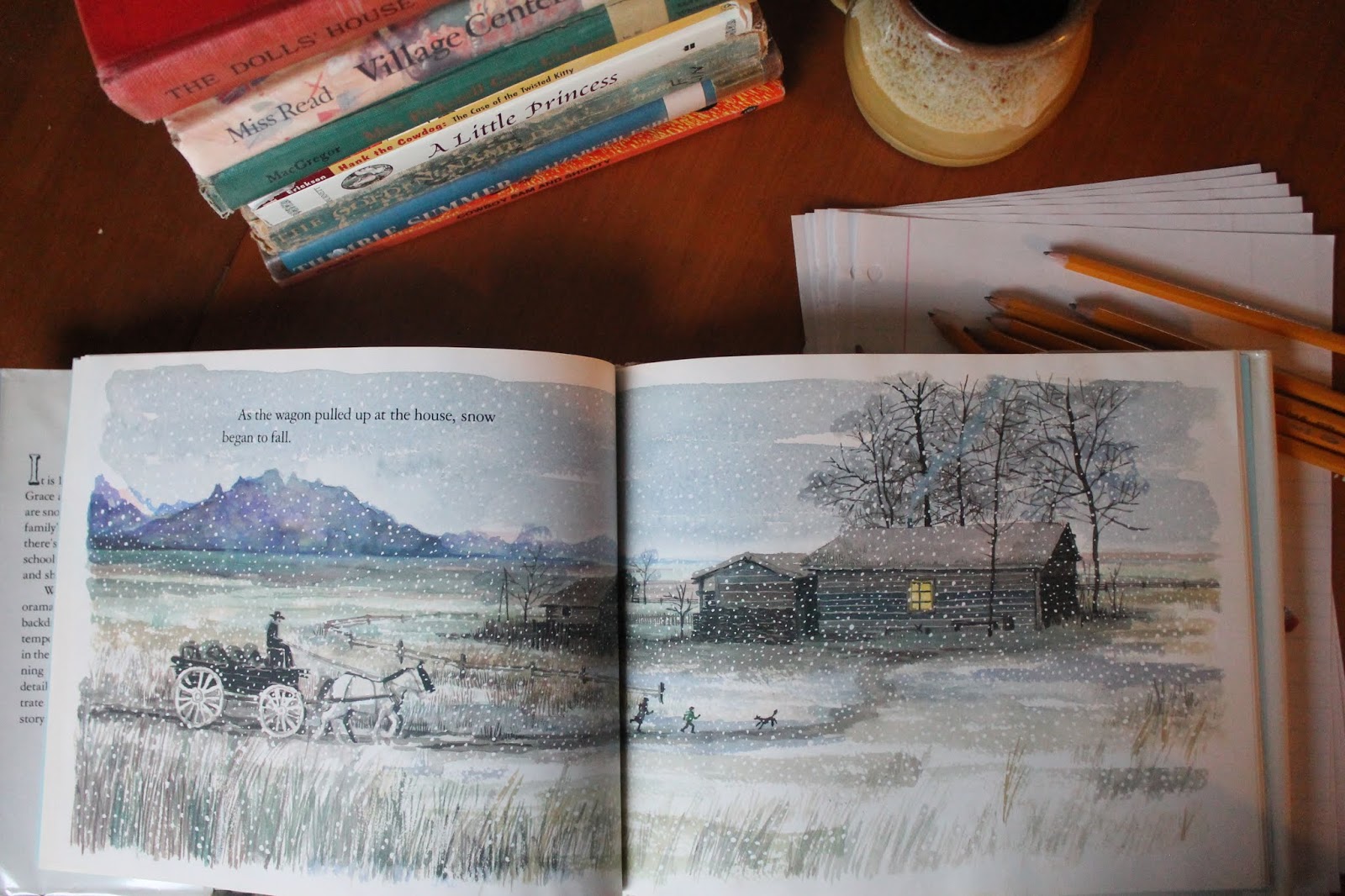
This is the story of Grace and Luke. At first you think they are just waving goodbye like a regular day. 


But then they go to the store and pick up a lot of supplies. 


And they get boxes filled with books from the library. 


Snow is just beginning to fall as they reach home. 


By the next morning, they are snowed in for the rest of the winter. 

As a child, that sounded enchanting. As an adult, it sounds a little petrifying. I like staying at home as much as the next person, but.... I can leave when I want. I can imagine feeling a little boxed in if I couldn't leave. 


They do their chores. 

And read. 


I have always had a bit of a love affair with the west, so a book combining the west and a love of reading is going to win me over pretty easily. 


Apparently this story came from a cowboy Barbara Lucas talked to once--he showed her some of his own writings and they talked about his schooling, since his writing showed an incredible depth of literary knowledge and intelligence. He said he got to school when he could, but was often snowed in for the winters, so his parents always made sure there were a lot of books around. 


Aren't these pictures great? 


Imaginary wanderings.

Heart eyes!


And then it was spring again and the way to town thawed out. 

As long as the supplies held out, no one got incredibly sick, the house didn't burn, and no wolves/bears/murderers came to call, I could see this being an idyllic time. 

Basically, I would like to be a pioneer, but with no inconveniences. Sounds reasonable. 

Tuesday, November 20, 2018

Stranded at Plimoth Plantation 1626 by Gary Bowen


Not the first Thanksgiving, but sort of Thanksgiving-y. So here you are. 

I love the wood cut illustrations, which is why I picked it up. 


I love cloud faces blowing ships around. 


This book is the fictional diary of 13 year old Christopher Sears headed for Jamestown. As you may have suspected from the title, this book is about "Plimoth" not Jamestown. Because surprise! the ship crashed on the New England shore.  


Fortunately, Native Americans rescued the shipwrecked sailors and delivered them to the Pilgrims.


In the intervening year between ships, Christopher became immersed in the lives of the Pilgrims, recording the births, deaths, arrests, and excitements of their lives. While it is entirely fictional, it is researched enough to accurately depict life in Plimoth. (Why is there a "y" in Plymoth now? Did he just not know how to spell Plymoth? Clearly he had not installed grammarly on his notebook.)


Poor Christopher--enduring peeping Puritains. 

When I was dressing this morning, by accident my shirt went on inside out. Elinor Adams, who was peering into the house through a crack in the wall, screamed at me not to reverst it. She said to wear it that was for it was a sign of good luck. 

I am unaccustomed to this Puritan notion of constantly checking the wrongdoing  of others.

 You and me both, Christopher. How is it okay to spy on people getting dressed? I think they call if voyeurism these days. 

And Christopher burned his finger and ripped his pants, so not lucky, Elinor. Nice try. 


A death


I love order. I know it is super boring. But I do. 


Pretty marvelous sunset.

Inevitably, Christopher begins to wonder if maybe life would be better for him here in the place he is familiar with rather than the unknown Jamestown. But there is the small detail of being indentured to a Captain.... But with Captain Standish on his side, Christopher might just win out. 

For some reason, I was always fascinated by Plymoth. The Puritans were so... restrained and bizarre at the same time. The chance of actually surviving so minuscule. The whole idea so audacious. Also, I read a book I really loved named... Constance or something like that about a Puritan girl. And I was a history nerd. 

Monday, August 29, 2016

Sweet Home Alaska by Carole Estby Dagg


I saw this book in the new section at our local library this spring. I was smitten as soon as I saw the title, and the synopsis on the inside flap only increased my interest. Young book loving girl moving to Alaska during the Great Depression as part of FDR's Matanuska Colony? Oh yes. Having lived in the Matanuska Valley of Alaska for several years my self, I couldn't help but glom onto this with the highest hopes. 

And for the most part, it succeeds. I was initially a little leary of all the Laura Ingalls Wilder references on the back of the book. For whatever reason, the publisher made it sound like Terpsichore was running around, checking off some sort of Larua Ingalls Wilder checklist. Since Laura Ingalls Wilder had only published one or two books during the time period this book was referring to, I felt that was a little inauthentic sounding. People nowadays try to be just like Laura or run around in a sunbonnet pretending, but in the 1930's, Laura Ingalls Wilder was just a new, interesting, and fairly popular author. She had not attained cult status. 

Fortunately, Terpsichore just admires Laura and only very occasionally mentions her. She isn't basing every decision on What Would Laura Do? So now we have a girl moving to Alaska  who admires Laura Ingalls Wilder. How cool is that? 

But it gets cooler! Terpsichore (pronounced terp-sick-o-ree) loves gardening and was active in her local library in Wisconsin. She is determined to bring culture (in the form of a library) to the last frontier and to grow the largest pumpkin Alaska has ever seen. She sets up the first library in Palmer, storing books in one of the Matanuska Colony tents. Terpsichore is fictional of course, but Palmer Library did begin as a collection in a Matanuska Colony tent. Carole Estby Dagg does a great job of seamlessly mixing fact with fiction. (Check out the history of Palmer Library if you would like to see where the facts come in.) 

And all kids need a good librarian to admire.


Carole Estby Dagg is a relatively new author, leaving her librarian job to learn more about writing. She published her first book at 67 (speaking of Laura Ingalls Wilder...) and this is her second book. She says that once upon a time, she was the library girl at their local school--doing story time for little kids and helping kids check out books. There is a lot of Dagg in Terpsichore. Also, Dagg's son lives in Palmer, AK, so she has a vested interest in all this history.


Terpsichore is a strong, determined young lady. She really wants to move to Alaska to stick by her close friend, whose family decided to take advantage of FDR's program and move from the collapsing economy of Northern Wisconsin. Terpsichore's father is interested in moving to AK as well, but you have to be on relief to qualify. He has worked and worked to not go on relief, so this seems a bit raw to him. Terpsichore's mother is definitely anti-AK. She would prefer living with her rich mother in Madison. 

A little careful conniving by Terpsichore, and a good deal of convincing for her mother, gives the family a chance to be part of the Matanuska Colony.  Terpsichore's enthusiasm wanes as she learns her best friend's family is not moving to Alaska, but their course is set and she must leave her friend behind. North they go!

The entire process of getting to Alaska, all the bureaucratic hoops they must jump through, is fascinating. There was a lot of careful research to make it all seem authentic. I feel like Carole Estby Dagg could have done a better service to Alaskan scenery, though. Having been through the inside passage and knowing the area she is talking about, the landscape is completely staggeringly beautiful. Terpsichore doesn't seem to notice. There are brief mentions of it, but not the rhapsodical odes that it seems to merit. But then, that might be more in keeping with most young kids world view. Terpsichore is more interested in the people she meets than the mountains. I just happened to be a shy kid who liked to stare at the landscape. 

Arriving in Alaska in the spring and living in a colony of tents is just as muddy and mosquito filled as you would think it would be. Terpsichore's mother is more convinced than ever that living with her mother is a better idea than this muddy, mosquito filled tent town, so she gives a year and a half ultimatum. If they haven't made good by then, they get to move back to Wisconsin. Terpsichore sets about making sure that doesn't happen, making friends, settling in, and making Alaska a home along the way. Her efforts to make her mother love Alaska bring her finally to the Alaska State Fair, at the end of August.  

This is a book about a young girl finding her way in the world while America's last frontier is being settled.  Terpsichore's determination and pluck make you love her, while her set backs make her relatable. 

There are several notable historical facts that Dagg includes, like Will Roger's stop through Palmer that makes this book worthwhile reading for young kids learning American History. 

This is a good 'un!

Wednesday, May 4, 2016

Dandelions by Eve Bunting & illustrated by Greg Shed


Eve Bunting is an amazingly prolific writer. Her writing is enjoyable, but it doesn't often move or excite me. This book changed that. Reading it before deciding if it should go in the donation pile, I got weepy. I decided it deserved a spot on our overcrowded shelves. 

Dandelions (I totally got this book because I liked the title--I love dandelions.) is about a family settling on the plains of Nebraska. The nearest neighbor is three hours away and Zoe's mother is expecting another baby and not at all sure about leaving their life in the east to move to an empty land. 


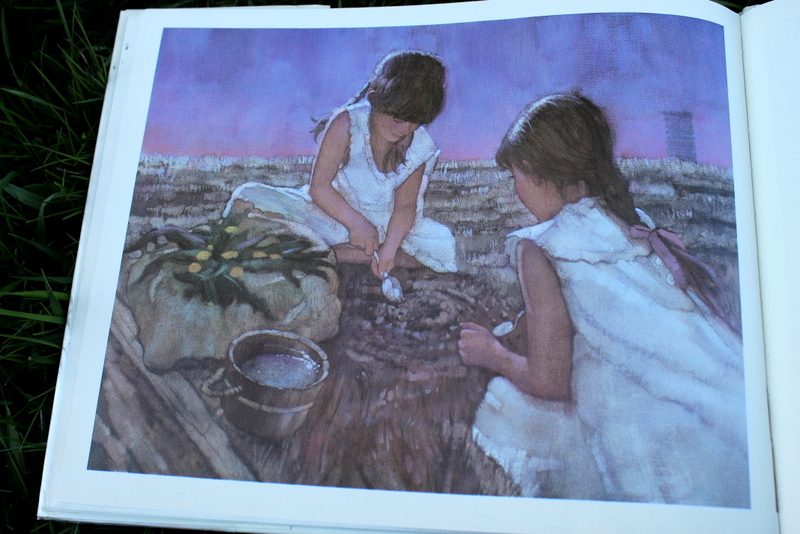
The pictures are gorgeously evocative of the rolling plains.


Clearly this Bolton family is moving because Papa decided they should move. When I think of pioneer women, I often think of hardy, adventurous, fearless women. This book paints a somewhat different picture. In that day, and in that time, men made plans. Men sometimes discussed the plans with their wives, but it was generally expected that the wife would say "You'll do what is best for us." 


Probably a good number of the women of the west were there against their wishes. But they made the best of it. They did what needed to be done and they (most often) flourished. Emma, Zoe's mother is still adjusting to the plains. She isn't complaining, but you can sense her hesitancy and longing for the east. This wide empty land frightens her. 


On the other hand, her husband feels completely right about what he is doing. God is mentioned several times, lending a sense of Manifest Destiny to Papa's actions. He is moving west and God is leading him. How could he doubt himself?

But he is so excited and thrilled with it all, you like him. He also is gentle with his wife, so he isn't totally heartless. 


They drive three hours to see their closest neighbors.

Mama and Mrs. Svenson met and hugged and cried. 
"Does Mama know her already?" I whispered to Papa.
"No. But they are happy to see each other. It has been a long time since either of them has seen another woman." He sounded sad, but Papa is never sad for long. "It will be different soon. Other settlers will come."


The Svenson's soddie


Papa had taught Zoe and Becca the stars and told them they were the same stars they saw from their window at Grandma and Grandpa's back in Illinois. The girls name the stars for the Svenson boys, who are are unimpressed. Only people and animals have names, they said.


Heading back to the homestead after their visit.


With a plow borrowed from Mr. Svenson, they plant crops before building their soddie. One night Zoe overhears her father talking to her mother--
"Don't you see? I could never have made a life for us in Illinois. It will be good here." It was as if he was pleading with her, and I felt sorry for him though I wasn't sure why.

He does care about his wife.


The finished soddie--
Mares- tail clouds waved in the sky and the grass sang around us.
I'd never seen Papa so happy or Mama so sad. 


Mama thought the soddie disappeared like a prarie dog burrow as soon as you moved away from it. She constantly worried that the girls or her husband would get lost in the vast prairie. 

Mama would stand for hours looking at the curve where the grass and sky met. "Always nothing." she'd say. "Always the sameness." 
I was glad when she spoke, even to herself. It was her silences that scared me. Sometimes I felt she'd gone away and I couldn't find her.


As summer came to an end and Mama's birthday approached, their supplies ran low. Since Mama was very pregnant, Papa drops her and Becca (the younger sister) off at the Svensons. 

Zoe and Papa set off for town. Mama hurries after them to ask if he is sure he can find his way back to her. I'll mark our path with breadcrumbs he tells her.


Papa worries a little out loud about Emma-I pray God I have done right by her.

He tells Zoe that there is a little extra money and they will look for a present for her.


In town they stock up and get a bottle of lilac scent to make Mama think of the lilacs back east. Zoe hopes it will make her happy and not sadder.


As they are leaving town, Zoe spies a clump of dandelions and decides they must be her present to her mother. If the dandelions could cover the roof of their soddie, Mama wouldn't be so afraid of getting lost because their roof would stand out like yellow sunshine for miles around.

Okay, I love this whole part. They dig up the dandelions and tenderly care for them while they are carting them home to transplant. Maybe Zoe is responsible for all the dandelions all of Nebraska is pulling of their lawns now. 


Papa puts the dandelions on the roof after dark. In the early dawn, Becca and Zoe creep up to the roof to plant them.  


Mama thinks an animal is on the roof and comes out to see what is happening. The Dandelions are limp and unimpressive looking much to Zoe's disappointment. Papa consoles her--"They'll cover the roof and they'll shout: 'This is home!' But their roots have to take hold first. It isn't easy being transplanted."

Maybe they'll never bloom," Mama said. "Maybe they'll just die of loneliness." Then she squeezed my hand. "Oh Zoe! I didn't mean... You were such a dear girl to think--"

I interruppted."They'll bloom, Mama. They're strong, like us." I was almost crying and I didn't know why. 
Mama and Papa were looking at each other. This was about more than dandelions.
Mama gave a shaky sigh.
Mama pulled me close. "Don't expect a miracle Zoe. It will take time."  


I love Zoe thinking she can fix her lonesome, worried mother with a dandelion plant. The childish desire to help in some way and the practical approach--if Mama is scared of getting lost, we will make her a landmark. Mama's worry of getting lost is about a lot more than just needing a landmark, but I love how she responds to what Zoe had done for her. It wasn't just a dandelion. It was all Zoe's worry and concern and love for her mother. Zoe doing what she could even though it was inadequate. And because of Zoe's efforts her mother was touched in a way that brought a little hope to their lives. Maybe Mama could take root and bloom in this place. 

Because she is strong--like a dandelion. She just needed to be reminded of her strength.


So here is to all the amazing women and mothers who settled the west. Who settled the west in fear and trembling, but learned to bloom in their wide, lonesome spaces.

Monday, April 18, 2016

Buffalo Music by Tracey E Fern & illus by Lauren Castillo


This awesome book is a fictionalized account of Mary Ann Goodnight's conservation efforts on behalf of the American Bison. At a time when Buffalo herds were seen as so many hides for the hunters, Mary Ann realized their intrinsic worth and started her own herd to ensure their continued existence.  

I love this book. And buffalo.


The main character Molly and her husband Charlie move to the Palo Duro Canyon area of Texas, when large herds of Bison roamed free. The rhythm of their lives, the "Buffalo music" was the backdrop against which Molly went about her life. 

"I stirred the fire to the huff-huff of buffalo breath clouding the chill dawn.
I hoed the garden to the scritch -scritch of buffalo scratching themselves against the cottonwoods.
I scrubbed the bedclothes to the slosh and splash of buffalo bulls wallowing in the mud hole. 
I swept the dugout to the thunder of buffalo as they drifted like a dark cloud across the prairie."


Then came the buffalo hunters.


Soon Charlie and Molly were driving past huge piles of buffalo bones. Within six years, the buffalo were mostly wiped out.

Molly's buffalo music had come to a discordant and abrupt end. 


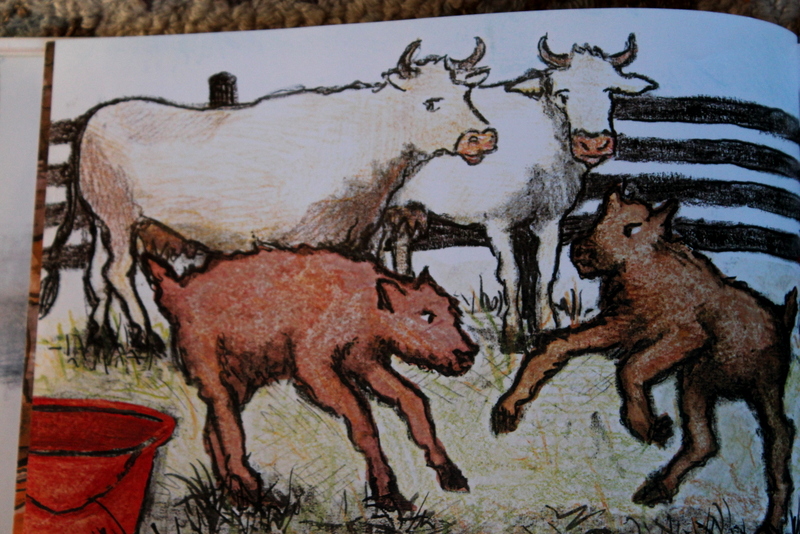
One day, a young cowboy discovered two small buffalo calves sleeping under a juniper. Knowing Molly was tenderhearted to animals, he brought them straight to her.


Molly decided to do her best with the calves. Her husband was skeptical. 

"But Charlie knew better than to waste his breath arguing with me. When I got a notion, a wise man knew to let me have my way."


She brought them into the cabin and wrapped them up.


Soon the calves were running around with the milk cows, growing healthier and stronger by the day. 


Molly's success with the two orphan spread throughout Texas. Soon any orphan calves found were brought to Molly. 


She cared for them and protected them--giving them space to grow. 


Within time, she had one hundred head of buffalo.


When she heard Yellowstone Park was trying to rebuild its buffalo herd, Molly sent four Bison north to Yellowstone. 

Because of Mary Ann Goodnight and others like her, the bison roaming the American West were saved. The Goodnight herd formed one of only five herds from which  most of the modern buffalo are descended. It is safe to assume that without the timely intervention of these early conservationist, the American buffalo would have been entirely destroyed. 

Hats off to Mary Ann Goodnight.