Showing posts with label US States book. Show all posts

Monday, August 29, 2016

Sweet Home Alaska by Carole Estby Dagg


I saw this book in the new section at our local library this spring. I was smitten as soon as I saw the title, and the synopsis on the inside flap only increased my interest. Young book loving girl moving to Alaska during the Great Depression as part of FDR's Matanuska Colony? Oh yes. Having lived in the Matanuska Valley of Alaska for several years my self, I couldn't help but glom onto this with the highest hopes. 

And for the most part, it succeeds. I was initially a little leary of all the Laura Ingalls Wilder references on the back of the book. For whatever reason, the publisher made it sound like Terpsichore was running around, checking off some sort of Larua Ingalls Wilder checklist. Since Laura Ingalls Wilder had only published one or two books during the time period this book was referring to, I felt that was a little inauthentic sounding. People nowadays try to be just like Laura or run around in a sunbonnet pretending, but in the 1930's, Laura Ingalls Wilder was just a new, interesting, and fairly popular author. She had not attained cult status. 

Fortunately, Terpsichore just admires Laura and only very occasionally mentions her. She isn't basing every decision on What Would Laura Do? So now we have a girl moving to Alaska  who admires Laura Ingalls Wilder. How cool is that? 

But it gets cooler! Terpsichore (pronounced terp-sick-o-ree) loves gardening and was active in her local library in Wisconsin. She is determined to bring culture (in the form of a library) to the last frontier and to grow the largest pumpkin Alaska has ever seen. She sets up the first library in Palmer, storing books in one of the Matanuska Colony tents. Terpsichore is fictional of course, but Palmer Library did begin as a collection in a Matanuska Colony tent. Carole Estby Dagg does a great job of seamlessly mixing fact with fiction. (Check out the history of Palmer Library if you would like to see where the facts come in.) 

And all kids need a good librarian to admire.


Carole Estby Dagg is a relatively new author, leaving her librarian job to learn more about writing. She published her first book at 67 (speaking of Laura Ingalls Wilder...) and this is her second book. She says that once upon a time, she was the library girl at their local school--doing story time for little kids and helping kids check out books. There is a lot of Dagg in Terpsichore. Also, Dagg's son lives in Palmer, AK, so she has a vested interest in all this history.


Terpsichore is a strong, determined young lady. She really wants to move to Alaska to stick by her close friend, whose family decided to take advantage of FDR's program and move from the collapsing economy of Northern Wisconsin. Terpsichore's father is interested in moving to AK as well, but you have to be on relief to qualify. He has worked and worked to not go on relief, so this seems a bit raw to him. Terpsichore's mother is definitely anti-AK. She would prefer living with her rich mother in Madison. 

A little careful conniving by Terpsichore, and a good deal of convincing for her mother, gives the family a chance to be part of the Matanuska Colony.  Terpsichore's enthusiasm wanes as she learns her best friend's family is not moving to Alaska, but their course is set and she must leave her friend behind. North they go!

The entire process of getting to Alaska, all the bureaucratic hoops they must jump through, is fascinating. There was a lot of careful research to make it all seem authentic. I feel like Carole Estby Dagg could have done a better service to Alaskan scenery, though. Having been through the inside passage and knowing the area she is talking about, the landscape is completely staggeringly beautiful. Terpsichore doesn't seem to notice. There are brief mentions of it, but not the rhapsodical odes that it seems to merit. But then, that might be more in keeping with most young kids world view. Terpsichore is more interested in the people she meets than the mountains. I just happened to be a shy kid who liked to stare at the landscape. 

Arriving in Alaska in the spring and living in a colony of tents is just as muddy and mosquito filled as you would think it would be. Terpsichore's mother is more convinced than ever that living with her mother is a better idea than this muddy, mosquito filled tent town, so she gives a year and a half ultimatum. If they haven't made good by then, they get to move back to Wisconsin. Terpsichore sets about making sure that doesn't happen, making friends, settling in, and making Alaska a home along the way. Her efforts to make her mother love Alaska bring her finally to the Alaska State Fair, at the end of August.  

This is a book about a young girl finding her way in the world while America's last frontier is being settled.  Terpsichore's determination and pluck make you love her, while her set backs make her relatable. 

There are several notable historical facts that Dagg includes, like Will Roger's stop through Palmer that makes this book worthwhile reading for young kids learning American History. 

This is a good 'un!

Thursday, June 23, 2016

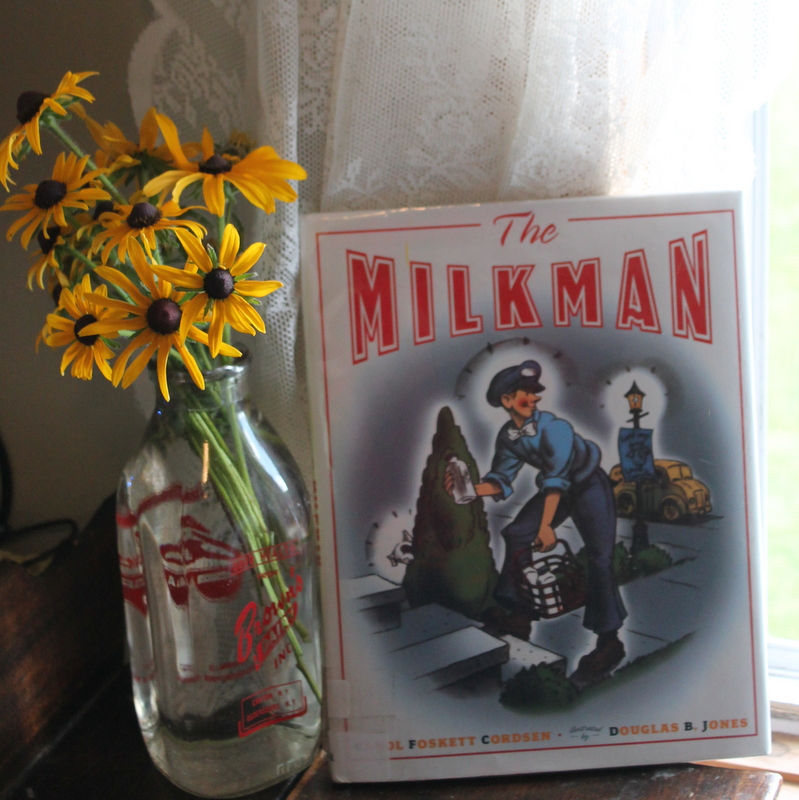
The Milkman by Carol Foskett Cordsen & illus by Douglas B. Jones


One day, while poking around a bookstore in Denver, CO I saw this book written by a local author. I fell in love with the faux vintage illustrations and the rhyming/choppy phrases, but since we were living in a rental condo in Steamboat and had no kids, I couldn't justify buying it. Several years later I saw it at our local library and remembered how much I liked it. 

And now I own a copy. Because I am like that. MUST OWN ALL GOOD BOOKS


Mr. Plimpton is out of bed and going through his morning routine.

Loud alarm clock. Snoring stops.
Mr. Plimpton our of bed

Cream in coffee. Egg on bread. 
Milkman jacket. Milkman hat.


Cranky pickup. Cranky cat. 


Driving in to work.


And then I got distracted by the brown eyed susans in the sunlight. I love brown eyed susans. 


The dairy where he picks up his truck.


And out he goes on his rounds.


Lost my dog 
Love, Caroline.

There is a dog to look for in all the pictures. Which adds another layer of charm to this book.


Do you see the dog?! Mr. Plimpton is just a nice guy. We like Mr. Plimpton.


I spy, with my little eye....


Next to lamppost, under sign. 


Lost dog home to Caroline.
I remember reading an article about the difference between 1950's neighborhood life and now. There was a stay at home mother in almost every house you walked past on the way to school in the 1950's. Which meant there were a lot of eyes watching you as you went about your life. So things were safer for kids out without their parents back then. And I think people like the milkman, (who soon went out of fashion) were part of that world and that net of safety. They saw things everyday and noticed when things were different.  
Not that I want to go back to the 1950's, thankyouverymuch. Just an interesting thing to ponder. 


Mr. Plimpton brings his milk truck back to the dairy.


...and heads home.  


Last stop, best stop. Cat jumps out. 
"Daddy's home!" comes happy shout.

Excitement at Daddy coming home never goes out of fashion.


Happy Family-ness.


Sun up red!


And just one more brown eyed susan picture!

Tuesday, June 7, 2016

The Girl in the Well is Me by Karen Rivers


I have seen this book on various blogs and Amazon and snagged it off the New shelf at our library. 

I thoroughly enjoyed it. 

The plot is a bit thin, really--a girl is stuck in a well. By the end of the book (*spoiler alert!*) she is out of the well. That is the overarching plot. But reading Kammie's internal monologue while stuck in a well is worth the price of admission. I like this girl. 


(Since there are no illustrations to take pictures of, I will just show you little blips of parts I liked.)

I like people who stay gently where they are, a little bit behind what they are doing. They just sing. You think of the song first because it is so good, before you think of the person doing the singing. 

Preach it, sistah!

Kammie has recently moved to Nowheresville, Texas after a rather traumatic experience back in her hometown in New Jersey and has decided to reinvent herself by joining the popular girl club at school. In order to join the club, they demand Kammie change pretty much everything about herself. And then continue their initiation by having her sing a song while standing on a board. They neglect to tell Kammie the board is slightly rotten. Or that the board is covering up an old well. Whoopsie!


Kammie's Mom tells her to wave her freak flag high, but Kammie is of the opinion she is not a freak, so no, thank you. While in the well, Kammie decides popular girls are not all they are cracked up to be. They are not "your kind of people, honey" as her mother would say. This is majorly stereotypical, since I know some super nice, beautiful people, and some horribly mean geeky people. But there is an element of truth to this. And when you are in your younger years, it is hard to know exactly what kind of people are your kind of people. Everyone is a bit awkward in those in between years.     

While Kammie is stuck in a cold slimey well, the three   andys (Mandy, Sandy, Kandy) vaguely try to help by leaning into the well and telling her to wiggle up or just simply "Get out!" (Kammie is convinced that they are sharing one brain between the three of them, which is why they are so completely useless.) One of the    andys, while leaning into the well to say something, spits her gum in Kammie's hair. The    andys find this hilarious.

I hear Kandy's manic bellow of laughter. She laughs like nothing has ever been funny before and this is the funniest thing that humanity will ever achieve. 


After a long period alone in the well, Kammie hears something snuffling around outside. She thinks it might be a coyote. Then she pictures the coyote falling on her head. Since she has thoroughly rehashed her life up until this point, there is nothing else to think about, so she thinks about the coyote. I love her stream of consciousness thinking here. 

Plus, a silver french speaking coyote is a really great imaginary character. 


After a very long time, the three    andy's come back, with Kandy's Dad is tow. Kammie stops talking to the imaginary silver coyote and starts talking to real people again. She also slips a little lower in the well. And things start feeling a little weird. 


Kammie is definitely below the oxygen level in the well. Hallucinations abound. The zombie goats she thought might be below her (in a worst case scenario) start moving around. She talks to them in French too.

Eventually the National Guard is involved and Kammie is rescued from the well. But really, the well is just an interesting sideline to the main event. Which is getting to know Kammie. Her life is complex and her personality and way of thinking are worth knowing. Kammie, moving to a new town, is trying to navigate her tween years, which are always so fraught, even when you know everyone and don't have the weight of the past and other people's mistakes hanging over you. She is doing the best she can. She likes to picture people's souls like grapes. But once they lie and make big mistakes, their soul turns into a raisin. While in the well, Kammie sees that she "raisined out" by trying to join the popular girls. She needs to stay grape-y. And you can only do that by being yourself. 

Read it!

(I feel like this was a bit of a fluff overview of this book, but if I got too deeply into the complexities of Kammie's life, it seems like it would give too much away. And I am trying to learn not to give too much away. So just read the book!)

Friday, May 27, 2016

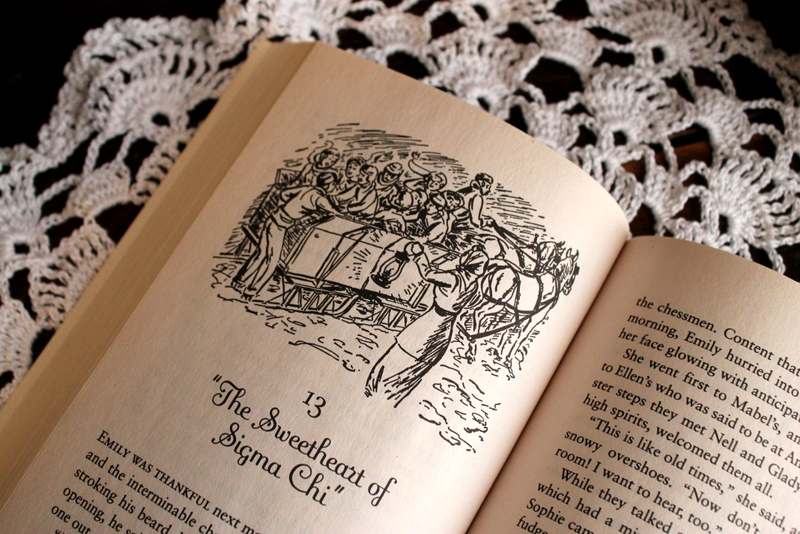
Emily of Deep Valley by Maud Hart Lovelace, Illus by Vera Neville


(I have decided I am rotten at quick synopsis of books. I go into way too much detail. So I am now going to be more concise and brief. Ha! It is just so hard when there is so much to say.)

Maud Hart Lovelace is famous for her Betsy-Tacy books, but this book, about another girl in Deep Valley is just as good. It has brief mentions of Betsy and Tacy's crowd, but really and truly, this is Emily's book. 

This is the story of an intelligent girl, stymied by graduating school and not being able to afford college. Eventually she finds useful occupation in Deep Valley and makes new friends to augment the friends away at college. 

(That was pretty brief wasn't it?)


I adore Vera Neville's girls. They are all so beautiful and elegant!


Emily lives with her grandfather, so she isn't at liberty to make plans without considering him. She doesn't have the freedom of heading off to college without a backward glance. Her grandfather is very kind and generous, but in his day, things were done differently, so he can't see the point in scrimping and saving for seeming trifles.


At the beginning of the book, her grandfather is completely consumed with plans for Decoration Day (Memorial Day) when he and his fellow Civil War veterans will march in the parade. Emily, on the other hand is busy with end of school activities. She and her grandfather are very close, but they are of completely different generations, so see the world and what is important very differently.


Graduation


The summer is a lovely mix of quietness in her slough, which Emily loves, and a whirlwind of friends and parties. When September comes, however, everyone leaves town. Emily has always loved the quietness of where they live, but suddenly, instead of quiet peacefulness, it seems oppressively empty and lonely.


Despite her best intentions, she falls into a little bit of a depression about the whole thing. For Grandfather's sake, she does her best to be cheerful and do the things that need doing.


Finally, the day before the first home football game, after a chance comment from a new coach at school about how she looked like a school girl with her hair in braids, she pulls herself together and decides she is not going the game. She isn't in high school anymore, and she is not going to languish around trying to pretend she is.

"The reason I didn't put up my hair was that I was clinging to high school," she thought. "There doesn't seem to be anything in my future, so I'm cling to the past. 
"But I can't stop living. I can't tie up my life like Chinese women do their feet. I've got to go on somehow."
"I don't know just what I can do, stuck here in Deep Valley.... But I know I'm going to do something, and I'm NOT going to go to the game this afternoon." 


 At church she hears the minister quote Shakespeare--"Muster your wits: stand in your own defense." When Emily pulls herself together, she does so quite admirably. She takes up piano lessons once again, starts a book club, takes dancing lessons, and buys a new dress.


While skating on the pond, she sees some boys treat a little Syrian immigrant she had befreinded earlier in the year very badly. She brings him home to her grandfather and feeds him up. Thus is born the idea for a Boys club for these immigrants.


Emily sets her plans in motion, and while she is still a little lonesome, she is busy and happier.


Her crowd comes home for Christmas, but somehow it isn't as joyful as Emily thought it would be. The boy she wants is obsessed with her cousin, as are all the other boys it seems. After a disastrous party, in which her cousin inveigles one of her hanger-ons to resentfully squire Emily, Emily is thankful for the quiet loneliness of her slough.

Emily realizes, "I tag them around, but I'm like a shadow. Well, I won't do it any more!" 
She wasn't tired of her friends, but she was tired of pursuing them as though her own life were worthless.


In an effort to be more on her own, Emily and her grandfather decide to give a Christmas party for some of the Syrians. As fall and winter progressed Emily had become more and more interested and involved with the immigrant community


Dancing at the New Year's Eve Party. Emily has some encouraging words from Betsy Ray about the usefulness of seemingly "wasted" years after high school.


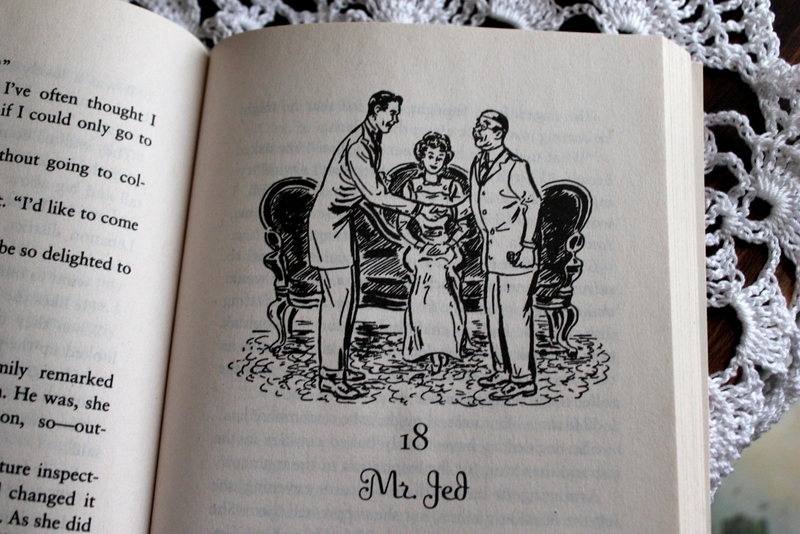
Through her work with the Syrian's, Emily becomes friends with the new coach at the school who had innocently commented on her hair looking like a high schooler's and set off all of Emily's changes, Mr. Jed. 


It is interesting to me how timeless things are. Syrian refugees and immigrants are very current subjects in our world today, as current as they were at the turn of the last century.


Jed and Emily get to be quite friendly through their involvement with the social services they create and supply to the Syrians. 


Eventually, there is a love interest of Emily's own. 

I love Emily. I love her natural responses of disappointment and dejection at not doing what she wants to do. And I love her resolution and plans to make her little world better rather than wallowing in the past or in her injustices. She becomes her own person and realizes it is possible to do so much good in the world without going about it in the prescribed manner she had in her own mind.

Tuesday, May 17, 2016

Strawberry Girl by Lois Lenski


This book is from Lois Lenski's Regional series, where she went to talk with/study kids in a certain part of the country and then wrote a book about them. This book is about the Florida backwoods. Written in the 1940's, this book won the Newbery award in 1946. I am a little on the fence about this book. It is about two familes, the Slaters and the Boyers and they bicker back and forth throughout the book. The Slater's have a drunk father and the Boyer's have a hardworking farmer father. I read this to the kids in bedtime installments a few weeks ago and they loved it, eagerly demanding the next few chapters. But I wasn't completely in love. It isn't saccharine as the cover might suggest, these are very interesting, flawed characters. There is some serious meanness and spitefulness in this book. Which is interesting. Not that I like mean books, but this is a much more accurate portrayal of the south than an white washed, kids bedtime version. But the storyline itself was a bit... well jagged at times. I have noticed that with several of Lois Lenski's other books. It was almost like she was trying to fit in a certain number of items and facts about the area and couldn't quite work them into the plot. So she just plugged them in anyway. Still, she won the Newbery for this, so clearly she knew what she was doing.

Also, all the characters have a hillbilly accent, which makes reading it a little difficult. I had to read slower to make sure I got in all the improper grammar use and southern hillbilly pronunciations that my mind automatically smooths out into normal grammar. But I guess it does add authenticity to the book.  


Birdie Boyer is the heroine of our book. 


The Boyer family moves into the old Rodenberry place, next door to the Sam Slater family. Here, Birdie is trying to spruce up the Slaters, a very poor, listless family. 


Birdie and Shoestring Slater strike up a friendship of sorts.


The Boyer's want to raise crops and the Slaters think they are ridiculous. Particularly Sam Slater who loves making trouble. Since Florida was free range at the time Slater lets his animals wander where they like, which was often the Boyer's painstakingly planted strawberry field.


The older Slater boys breaking up the school and beating up the teacher. I love the kids to the right, calmly leading the little kids out "If you would kindly step this way..."


Miss Dunnaway, who plays the organ at church and is Birdie's idol. 


After Bihu Boyer (Birdie's dad) fences in the strawberry field, Sam Slater tacks a warning note on the Boyer's porch warning of trouble if the fences (which block the quickest way to the lake) aren't taken down. 

Birdie rips it down before her father sees it and tells Shoestring his father is a coward for not coming and talking to her Dad.


The Boyer's, with hardwork and careful attention to what they spend can afford a few nice things. Meanwhile, the Slater family is buying the things they desperately need on credit, to be repaid that evening, when Sam Slater will pay the shopkeepers with the money he earned selling a steer.

Except he drank the money away. And Shoestring is forced to return all the merchandise to the shops. The Slater's, minus Sam, have to ask the Boyer's for a ride home. Poor Slaters. 


Florida summer heat


Since Sam Slater is unconcerned with most things except drink, Shoestring has plenty of time for catching animals, including big ole turtles.


The Boyer's have a cane grinding. Which seems a little similar to sugaring off parties of the north. The Slater's come and have a lovely time. Then on the way home, Sam Slater cuts all the brand new barb wire fence between each fence post. 

Bihu Boyer, puts new fence up. 


Working in the strawberry fields while Shoestring is out catching rattlesnakes. Birdie's mother solves the fence debacle by spreading flour over the strawberry plants when Sam Slater has his herd ready to trample the fences down on their way to water. Somehow, Sam Slater thinks the flour is poison. Not sure why. But it works. The Slaters take the long way around.


An alligator on the way to town.


Selling strawberries in town.


A grass fire comes too close to the Boyer's house and Birdie rushes to the Slater's for help. The Slater's aren't interested in helping because they helped set the fire. Mrs. Slater wants to help however. She is ordered back into the house for her pains. 


One night, while Sam Slater is off on a binge, Mrs. Slater takes ill and Shoestring comes to fetch Mrs. Boyer to help. Birdie goes with her and they end up staying for a week or two. 

Despite all that Sam Slater thinks up, Mrs. Boyer and Mrs. Slater become friends of sorts. Mrs. Boyer recognizes Mrs. Slater's hardship being married to Sam and does what she can to help. 


A traveling preacher visits while Mrs. Slater is sick in bed. 

Somehow, Sam Slater, while off on a binge finds religion. He is a reformed character. All is hunky-dory. Which is slightly suspect. I mean, it is too neat and tidy, just at the end of the book. It is almost like Lenski needed to resolve the conflict and this was the quickest way to do it. Sam Slater decides to sell his cattle herd and take a job at the phosphorous mines. So he will no longer be fighting with the Boyers. Ta-da! Slaters and Boyers, BFF's! 

Several people in the Amazon reviews of this book say that this book made them think more of the people who were poorer than they were and want to help them. Which is good. This book is actually a fairly good portrayal of poor folk of the time. But as the daughter of a social worker with 20 years experience, the Slater experience is incredibly rare. Alcoholics don't generally come to their senses in a short church service and quick cold turkey. But I guess there are a select few who do, so why couldn't Sam Slater?

Still, this is a good book, to learn about poor backwoods Florida Crackers (Crackers is used as a term of pride in this book. Like people calling themselves rednecks today, I guess.)  in this particular time period. 

(An interesting tidbit--Lenski says the term crackers apparently came from the large herds of cattle that were driven to market from the free range land of Florida and the drovers who cracked their whips over their back to keep them moving. Not sure if that is true or not.)


The lovely endpapers.