Showing posts with label social issues. Show all posts

Friday, May 27, 2016

Emily of Deep Valley by Maud Hart Lovelace, Illus by Vera Neville


(I have decided I am rotten at quick synopsis of books. I go into way too much detail. So I am now going to be more concise and brief. Ha! It is just so hard when there is so much to say.)

Maud Hart Lovelace is famous for her Betsy-Tacy books, but this book, about another girl in Deep Valley is just as good. It has brief mentions of Betsy and Tacy's crowd, but really and truly, this is Emily's book. 

This is the story of an intelligent girl, stymied by graduating school and not being able to afford college. Eventually she finds useful occupation in Deep Valley and makes new friends to augment the friends away at college. 

(That was pretty brief wasn't it?)


I adore Vera Neville's girls. They are all so beautiful and elegant!


Emily lives with her grandfather, so she isn't at liberty to make plans without considering him. She doesn't have the freedom of heading off to college without a backward glance. Her grandfather is very kind and generous, but in his day, things were done differently, so he can't see the point in scrimping and saving for seeming trifles.


At the beginning of the book, her grandfather is completely consumed with plans for Decoration Day (Memorial Day) when he and his fellow Civil War veterans will march in the parade. Emily, on the other hand is busy with end of school activities. She and her grandfather are very close, but they are of completely different generations, so see the world and what is important very differently.


Graduation


The summer is a lovely mix of quietness in her slough, which Emily loves, and a whirlwind of friends and parties. When September comes, however, everyone leaves town. Emily has always loved the quietness of where they live, but suddenly, instead of quiet peacefulness, it seems oppressively empty and lonely.


Despite her best intentions, she falls into a little bit of a depression about the whole thing. For Grandfather's sake, she does her best to be cheerful and do the things that need doing.


Finally, the day before the first home football game, after a chance comment from a new coach at school about how she looked like a school girl with her hair in braids, she pulls herself together and decides she is not going the game. She isn't in high school anymore, and she is not going to languish around trying to pretend she is.

"The reason I didn't put up my hair was that I was clinging to high school," she thought. "There doesn't seem to be anything in my future, so I'm cling to the past. 
"But I can't stop living. I can't tie up my life like Chinese women do their feet. I've got to go on somehow."
"I don't know just what I can do, stuck here in Deep Valley.... But I know I'm going to do something, and I'm NOT going to go to the game this afternoon." 


 At church she hears the minister quote Shakespeare--"Muster your wits: stand in your own defense." When Emily pulls herself together, she does so quite admirably. She takes up piano lessons once again, starts a book club, takes dancing lessons, and buys a new dress.


While skating on the pond, she sees some boys treat a little Syrian immigrant she had befreinded earlier in the year very badly. She brings him home to her grandfather and feeds him up. Thus is born the idea for a Boys club for these immigrants.


Emily sets her plans in motion, and while she is still a little lonesome, she is busy and happier.
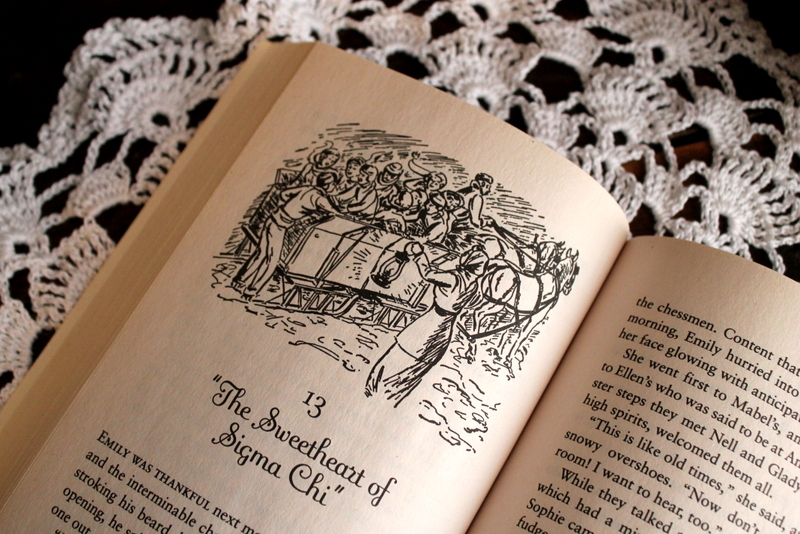

Her crowd comes home for Christmas, but somehow it isn't as joyful as Emily thought it would be. The boy she wants is obsessed with her cousin, as are all the other boys it seems. After a disastrous party, in which her cousin inveigles one of her hanger-ons to resentfully squire Emily, Emily is thankful for the quiet loneliness of her slough.

Emily realizes, "I tag them around, but I'm like a shadow. Well, I won't do it any more!" 
She wasn't tired of her friends, but she was tired of pursuing them as though her own life were worthless.


In an effort to be more on her own, Emily and her grandfather decide to give a Christmas party for some of the Syrians. As fall and winter progressed Emily had become more and more interested and involved with the immigrant community


Dancing at the New Year's Eve Party. Emily has some encouraging words from Betsy Ray about the usefulness of seemingly "wasted" years after high school.


Through her work with the Syrian's, Emily becomes friends with the new coach at the school who had innocently commented on her hair looking like a high schooler's and set off all of Emily's changes, Mr. Jed. 


It is interesting to me how timeless things are. Syrian refugees and immigrants are very current subjects in our world today, as current as they were at the turn of the last century.
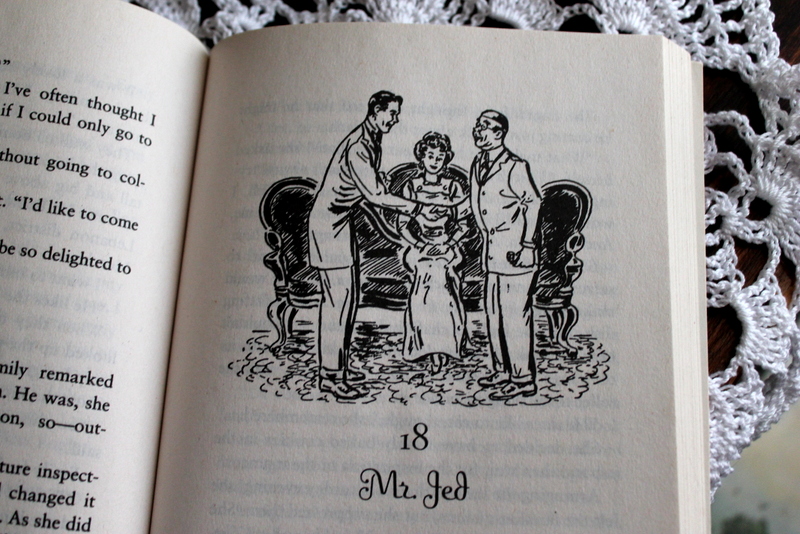

Jed and Emily get to be quite friendly through their involvement with the social services they create and supply to the Syrians. 


Eventually, there is a love interest of Emily's own. 

I love Emily. I love her natural responses of disappointment and dejection at not doing what she wants to do. And I love her resolution and plans to make her little world better rather than wallowing in the past or in her injustices. She becomes her own person and realizes it is possible to do so much good in the world without going about it in the prescribed manner she had in her own mind.

Tuesday, May 3, 2016

All Rise for the Honorable Perry T. Cook by Leslie Connor


Eleven year old Perry T Cook has lived inside the bars of Blue River Correctional Facility, a minimum security prison, all his life. Born not long after his mother Jessica pled guilty to a vehicular manslaughter charge, Perry has been able to grow up alongside her due to the clever managing of Warden Daugherty. Blue River offers Perry a roof over his head and an unconventional, but supportive family life, while he offers them the softening effect of innocence and the hope of a life beyond bars. Perry goes to school each day, sees his best friend Zoey and comes home to Blue River to high five the residents coming in from their work programs, do his homework and get ready for supper. After supper (with sporks), Perry and his mother plan for her parole that is only a month or two away. It is an unconventional life, but entirely satisfactory to Perry.

Then suddenly, an ambitious new district attorney discovers Perry living behind bars. Mr. VanLeer is convinced that living there has ruined Perry's life and is so determined to change Perry's life for the better, that he takes Perry home to live with him and his family as a foster child.

Perry, his mother, and all of Blue River is thrown into despair. Perry compares his life in the VanLeer household as that of a new intake in the prison. He has to serve a sentence there until his mother is released from parole--a parole that is suddenly thrown into jeopardy by VanLeer's interference. Knowing he has to adapt to life outside, without his mother and Blue River family, Perry follows Big Ed's advice to the newcomers in Blue River--(I paraphrased a little here)

Seek to succeed. 
 You're here to rise up. 
Eye on the end--keep a clear vision of how you want to emerge.
Give purpose to each day.
Seek to understand before you seek to be understood. 
Count your wins.

Although his life is unique, every young person reading this book can identify with Perry's struggles. Because Perry's struggle to make it living on the outside are similar to the struggles every kid faces as they try to find their way in the world. At some point we leave that which is familiar, we all face the unfairness of the world and the frustration of seemingly arbitrary rules that keep us back from the things we want most. 

Perry meets those struggles with determination, fortitude, ingenuity, and an amazing outward calm. Really, the calm is almost eerie. How can a child, pulled from everything dear and familiar not act out in some way? And through all the frustrations with DA VanLeer, Perry never looses his cool and hollers. Maybe the rigidity of life on the inside has instilled unplumbed depths within him?

Clearly Perry is more emotionally mature than I am. 

At close to 400 pages, this is on the longer side for the recommended ages (8-12), but the subject matter pulls you in and the pages seem to go quickly. 

All in all, I liked this book. Perry and his mother and the residents of Blue River are fascinating people. Their stories, that Perry collects for a school project, are believable and heartbreaking. You want good things for these people. 

Really everyone is terribly nice. If it wasn't a fascinating subject matter, the overall niceness of everyone (even the school bully comes round and helps Perry at a critical juncture in  his mother's parole hearing) might come off as fairly fake and sugar sweet. There are token "cold cases" in Blue River, the ones Perry is told to steer clear of, but even the main villian in the book, Mr VanLeer, turns out to be misguided more than wicked. 

The ending is happy. But a teensy bit unsatisfying. There were people I wanted to know more about--what motivated them to act as they did? And where did so-and-so end up? I didn't want the ending to change per se, I just wanted there to be an epilogue or something.

The characters are likable, the plot well done, and the story well paced. I did enjoy it. I just can't get over the eternal goodness of pretty much everyone in the book and my disappointment at the perfectly nice ending. Which is silly. I hate messy, angst-y books with depressing endings. But I need things a tiny bit more believable than this book. 

If you approach this as a fun, elevating book you will love it. If you approach it thinking you will get to the nitty gritty of kids with incarcerated parents, well, I am just not sure this delivers. 

Tuesday, April 5, 2016

The Secret Box by Joanna Cole, illustrated by Joan Sandin


This is a somewhat serious little book about a young girl, intent on having something of her very own, learning to respect other people's property as their own. Anne-Marie is a very busy older sibling, looking after her siblings, and doing a lot chores for her busy parents. Since she doesn't have much time to herself, she feels strongly about having something to herself and starts a secret box to store her treasures. 


Anne-Marie and her best friend, Vanessa on their way to school.


The secret box started out with beautiful buttons and a class picture, but was added to as Anne-Marie found things on the sidewalks of New York. 


Her parent's love her, but are so busy, they can be a bit short with her and expect a lot from her. 


Looking after her two little sisters, Rosa and Diana.


But at night, she gets out her secret box, which no one can know about, and has some time of her own to admire her treasures. 


She keeps her eyes pealed for things to add to her box. Unfortunately, she doesn't understand yet that people might be attached to their things as well. She sees her teacher's double sided pencil for correcting papers and thinks how lovely it would look in her secret box, so takes it. 


However pretty the pencil looks, Anne-Marie loves her teacher and worries what he will think of her for taking the pencil. She is quiet and dejected over breakfast. 


But when she gets to school, Mr. Freeman, her teacher, has another double sided pencil and doesn't seem to know or care that she took it. 


On the way to gym, Anne-Marie reacts to a boys teasing and is forced to sit out for the whole gym period.


Anne-Marie is mad. After sending mad looks to her teacher and the boy who teased her, she starts looking around. 


She sees a pencil case with a beautiful ring. Since Mr, Freeman's pencil went unnoticed, Anne Marie decides having the ring would make her feel better about sitting out. 

She tucks it in her sneaker until she gets home to her secret box. 


Enjoying the ring, although she is interrupted by her little sister. 


The next day, Vanessa is distraught because her ring has gone missing. Anne Marie feels like a stone has fallen into her stomach. 


It is a miserable walk home in the rain. 


The next morning, she gets to school early and slips the ring in Vanessa's desk. As she walks to the pencil sharpener, she is tempted by some crisp green play money on a boy's desk. How nice it would look in her secret box! But then she remembers how upset Vanessa was about losing her ring and decides the boy might be just as attached to his play money and leaves the play money alone. 


Vanessa finds the ring and thinks she simply misplaced it.

Throughout the book, Anne Marie is never found out. She doesn't have to face punishment beyond the weight of her own conscience. Because of that, this book feels much more realistic. Anne Marie is a very likable, hard working girl. It is so easy to understand her longing for something of her very own. You sympathize with her, even as she is pocketing Mr. Freeman's pencil. (Who didn't long for one of those two sided pens teachers used for correcting papers?) As Anne Marie comes to the realization that taking things for her very own is negatively affecting her best friend, she learns empathy. Having a shiny ring in her treasure box to admire all by herself, is not worth as much to her as her friend's happiness. 

The adult in me wishes she had put Mr. Freeman's pencil back as well, but her keeping the pencil definitely gives kids something to think about. Is stealing okay if it doesn't really bother the person you stole from? This is a philosophical question that is good for kids to think about. Is wrong wrong, even if no one knows or cares? 

Friday, March 11, 2016

Miracles on Maple Hill by Virginia Sorenson illustrated by Beth and Joe Krush


This was one of my favorite childhood books. I loved this book. I read it about 15 times. (Or thereabouts.) I bought the audio CD of this for my kids a few years ago, and now I have listened to it a few hundred times. We all love it. 

Set in Pennsylvania, this winner of the 1957 Newbery follows ten year old Marley and her brother Joe as they get used to living on a long empty family farm in Western PA. Needing peace and quiet and something to do after being a prisoner of war in WWII, their father moves out to the farm, and Marley, Joe, and Mother commute between their city life and the farm each week. Mr. Chris, a neighbor who has known the family for years, promises to show Marley a miracle each weekend she comes to the farm. Slowly, her father comes back from the terrible emotional place he has been and Maple Hill becomes a precious place to the whole family. There is a lot of overcoming and joy and love in the book, as well as a lot of nature. Mr. Chris is always showing Marley or Joe a plant or tree or natural phenomena. Not to mention the sugaring. Oh, the sugaring! No wonder I adored this book! 

I also love Beth and Joe Krush illustrations. They were a husband and wife team, quite popular in the 1940's and 50's, with several illustrated chapter books to their credit. They were both illustrators in their own right, but started helping each other meet deadlines. Eventually, they just worked as a team. 

(Interesting wikipedia tidbit, Joe Krush was a court sketch artist at the Nuremberg trials.) 


Marley and the farm. 


Meeting Mr. Chris in the sugarbush


Mother showing Marley the view from her old room that would now be Marley's room. 


In the Sugar Shack


Marley, lured  into the cows pasture by some pretty flowers, is slightly concerned about the cows and their intentions.


Harry the Hermit and the family's first livestock.


Marley and her friend Margie


Collecting sap. Love this picture!


Having Mr. Chris test the maple syrup they had made without him. 

Friday, January 15, 2016

The Empty Schoolhouse by Natalie Savage Carlson

I  haven't written about any chapter books yet, so in honor of Martin Luther King Day, here is a good one. 


This book is about desegregating parish schools in Louisiana, from a black family's perspective. Emma Royall, at 14 is the oldest child in the family and has quit school. Her younger sister Lullah adores school and is terribly excited about leaving the colored school and going to the parish school with her white best friend, Oralee. Little Jobe is the youngest and isn't in school but highly anticipating it. Plus he is an energetic little imp, which delighted my kids. 


I love this picture of the two girls walking. 


The book opens with a picnic with Oralee and all is (mostly) peace and happiness. 


The community is built around the church and everyone seems to have a respect of sorts for the Royall family. But one family feels strongly about blacks not entering their school, so calls in some outside toughs to come and intimidate the black kids on their first day of school. When the name calling doesn't deter the new black students, they start on harsher things. Throwing rocks in windows at night and threatening white men's jobs if they continue to let their kids go to school with blacks.


(I love the little pictures by the artist best. But then, I just like little pictures.) 


Eventually, everyone pulls their kids out of the school. Lullah goes back to her old colored school. Suddenly, Oralee has a new best friend, a white girl. The new best friend is horrid and tries to make it hard for Lullah to play with them. Oralee just goes along, fascinated by her new friend. This is typical child behavior, but against the backdrop of segregation, it feels much harsher. This picture of Lullah watching them play from across the street because she is not allowed to go into the white's only playground is particularly heartbreaking. 

Segregation was so horrid.


After another incidence of Oralee being carelessly rude, Lullah is heartbroken, but determines to go back to the empty Parish school. The nuns had continued to open the school and expect students every day. 

As Lullah returns to the school as the only student, the threats kick up again. Eventually things come to a head and the result makes the white families, who had always like the Royall family, realize how ridiculous it was to let outsiders stir everyone up. 


In some ways, this book is a somewhat gentle handling of the segregation/desegregation issue. It has violence and hatred and horribleness, but most of the whites are basically decent people, effectively threatened into submission by nasty people. One family moves away at the end of the book, but that is no great loss to the neighborhood. 

Yet, the fear that decent white people had is one of biggest reasons segregation was allowed to drag on so long. History is full of horrible events and situations where seemingly decent people act terrible or allow others to be horrid unchecked. If more parents had told the outside agitators to go jump in the lake, the whole situation could have been avoided. 

The need for doing what is right even if no one else is very effectively illustrated in this book.