Showing posts with label coming of age. Show all posts

Thursday, February 14, 2019

The Blue Castle by LM Montgomery


This book. This BOOK. Both of my parents loved this book, so it has always been around. And when I read it as a young teen, I fell instantly in love with Valancy and Barney and Barney's cabin in the Ontario wilderness. 


It was one of the first love stories I ever read, so it ended up being a definitive romance. Every story since has been measured up against Valancy and Bernard. I know, I know. NOT romantic names. But they can't be blamed for what their parents called them. 

(Also, wild roses. I took these pictures last June, but never got it posted. Oh for wild rose days! They will be here soon, I guess. But this part of winter always seems to drag....)


Valancy is a sheltered spinster of 29, Bernard the local suspicious person who doesn't care what anyone else thinks. Not caring about what other people thinks in rural Ontario in the early 1900s was a pretty dire statement on someone's character. Clearly a person to steer clear of.  

After Valancy goes to the doctor for a chest pain and finds she has a terminal condition, she flouts her family's expectation and goes to care for a local, unwed mother. While there, she meets Bernard who comes to visit the lonely girl. Bernard is interesting in a way her family never was. Eventually, with a return to her family's home in the offing, Valancy goes to Bernard and proposes to him. She tells him of her terminal condition, which means he would not have to be married for ever. She argues they get along well and she could take care of his house, so why not? Why not indeed?

Much to her family's consternation, Valancy goes junketing off as Bernard's new wife. 

And of course, in the misty, purple evenings on a tiny island in a lake in Ontario, Bernard and Valancy become the best of friends and slowly begin to realize they are in love.

A little melodramatic, but oh! Going against society, finding a kindred spirit, a private island no matter how tiny, and a dramatic ending---how could I not love this book? 

There are times in this book that Lucy Maud talks a little too much. Some of the family chatter at the beginning seems a bit excessive. But it is entirely worthwhile to overlook these minor flaws. 

If you haven't already read this, give yourself a treat and do so. If you have already read it, give yourself another treat and read it over. I think I have read it about ten times.  

Monday, August 29, 2016

Sweet Home Alaska by Carole Estby Dagg


I saw this book in the new section at our local library this spring. I was smitten as soon as I saw the title, and the synopsis on the inside flap only increased my interest. Young book loving girl moving to Alaska during the Great Depression as part of FDR's Matanuska Colony? Oh yes. Having lived in the Matanuska Valley of Alaska for several years my self, I couldn't help but glom onto this with the highest hopes. 

And for the most part, it succeeds. I was initially a little leary of all the Laura Ingalls Wilder references on the back of the book. For whatever reason, the publisher made it sound like Terpsichore was running around, checking off some sort of Larua Ingalls Wilder checklist. Since Laura Ingalls Wilder had only published one or two books during the time period this book was referring to, I felt that was a little inauthentic sounding. People nowadays try to be just like Laura or run around in a sunbonnet pretending, but in the 1930's, Laura Ingalls Wilder was just a new, interesting, and fairly popular author. She had not attained cult status. 

Fortunately, Terpsichore just admires Laura and only very occasionally mentions her. She isn't basing every decision on What Would Laura Do? So now we have a girl moving to Alaska  who admires Laura Ingalls Wilder. How cool is that? 

But it gets cooler! Terpsichore (pronounced terp-sick-o-ree) loves gardening and was active in her local library in Wisconsin. She is determined to bring culture (in the form of a library) to the last frontier and to grow the largest pumpkin Alaska has ever seen. She sets up the first library in Palmer, storing books in one of the Matanuska Colony tents. Terpsichore is fictional of course, but Palmer Library did begin as a collection in a Matanuska Colony tent. Carole Estby Dagg does a great job of seamlessly mixing fact with fiction. (Check out the history of Palmer Library if you would like to see where the facts come in.) 

And all kids need a good librarian to admire.


Carole Estby Dagg is a relatively new author, leaving her librarian job to learn more about writing. She published her first book at 67 (speaking of Laura Ingalls Wilder...) and this is her second book. She says that once upon a time, she was the library girl at their local school--doing story time for little kids and helping kids check out books. There is a lot of Dagg in Terpsichore. Also, Dagg's son lives in Palmer, AK, so she has a vested interest in all this history.


Terpsichore is a strong, determined young lady. She really wants to move to Alaska to stick by her close friend, whose family decided to take advantage of FDR's program and move from the collapsing economy of Northern Wisconsin. Terpsichore's father is interested in moving to AK as well, but you have to be on relief to qualify. He has worked and worked to not go on relief, so this seems a bit raw to him. Terpsichore's mother is definitely anti-AK. She would prefer living with her rich mother in Madison. 

A little careful conniving by Terpsichore, and a good deal of convincing for her mother, gives the family a chance to be part of the Matanuska Colony.  Terpsichore's enthusiasm wanes as she learns her best friend's family is not moving to Alaska, but their course is set and she must leave her friend behind. North they go!

The entire process of getting to Alaska, all the bureaucratic hoops they must jump through, is fascinating. There was a lot of careful research to make it all seem authentic. I feel like Carole Estby Dagg could have done a better service to Alaskan scenery, though. Having been through the inside passage and knowing the area she is talking about, the landscape is completely staggeringly beautiful. Terpsichore doesn't seem to notice. There are brief mentions of it, but not the rhapsodical odes that it seems to merit. But then, that might be more in keeping with most young kids world view. Terpsichore is more interested in the people she meets than the mountains. I just happened to be a shy kid who liked to stare at the landscape. 

Arriving in Alaska in the spring and living in a colony of tents is just as muddy and mosquito filled as you would think it would be. Terpsichore's mother is more convinced than ever that living with her mother is a better idea than this muddy, mosquito filled tent town, so she gives a year and a half ultimatum. If they haven't made good by then, they get to move back to Wisconsin. Terpsichore sets about making sure that doesn't happen, making friends, settling in, and making Alaska a home along the way. Her efforts to make her mother love Alaska bring her finally to the Alaska State Fair, at the end of August.  

This is a book about a young girl finding her way in the world while America's last frontier is being settled.  Terpsichore's determination and pluck make you love her, while her set backs make her relatable. 

There are several notable historical facts that Dagg includes, like Will Roger's stop through Palmer that makes this book worthwhile reading for young kids learning American History. 

This is a good 'un!

Friday, May 27, 2016

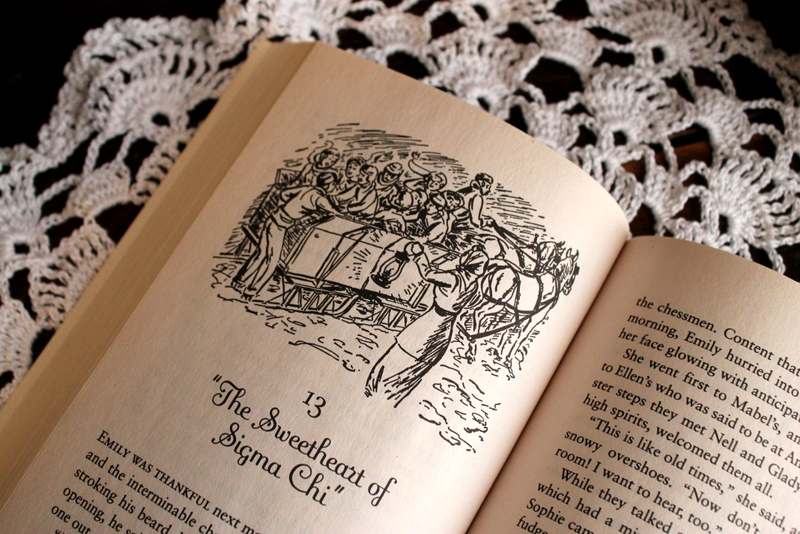
Emily of Deep Valley by Maud Hart Lovelace, Illus by Vera Neville


(I have decided I am rotten at quick synopsis of books. I go into way too much detail. So I am now going to be more concise and brief. Ha! It is just so hard when there is so much to say.)

Maud Hart Lovelace is famous for her Betsy-Tacy books, but this book, about another girl in Deep Valley is just as good. It has brief mentions of Betsy and Tacy's crowd, but really and truly, this is Emily's book. 

This is the story of an intelligent girl, stymied by graduating school and not being able to afford college. Eventually she finds useful occupation in Deep Valley and makes new friends to augment the friends away at college. 

(That was pretty brief wasn't it?)


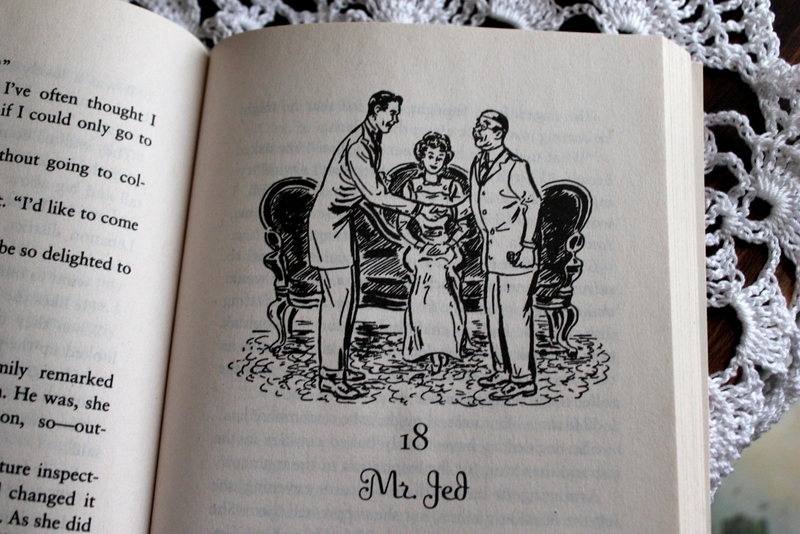
I adore Vera Neville's girls. They are all so beautiful and elegant!


Emily lives with her grandfather, so she isn't at liberty to make plans without considering him. She doesn't have the freedom of heading off to college without a backward glance. Her grandfather is very kind and generous, but in his day, things were done differently, so he can't see the point in scrimping and saving for seeming trifles.


At the beginning of the book, her grandfather is completely consumed with plans for Decoration Day (Memorial Day) when he and his fellow Civil War veterans will march in the parade. Emily, on the other hand is busy with end of school activities. She and her grandfather are very close, but they are of completely different generations, so see the world and what is important very differently.


Graduation


The summer is a lovely mix of quietness in her slough, which Emily loves, and a whirlwind of friends and parties. When September comes, however, everyone leaves town. Emily has always loved the quietness of where they live, but suddenly, instead of quiet peacefulness, it seems oppressively empty and lonely.


Despite her best intentions, she falls into a little bit of a depression about the whole thing. For Grandfather's sake, she does her best to be cheerful and do the things that need doing.


Finally, the day before the first home football game, after a chance comment from a new coach at school about how she looked like a school girl with her hair in braids, she pulls herself together and decides she is not going the game. She isn't in high school anymore, and she is not going to languish around trying to pretend she is.

"The reason I didn't put up my hair was that I was clinging to high school," she thought. "There doesn't seem to be anything in my future, so I'm cling to the past. 
"But I can't stop living. I can't tie up my life like Chinese women do their feet. I've got to go on somehow."
"I don't know just what I can do, stuck here in Deep Valley.... But I know I'm going to do something, and I'm NOT going to go to the game this afternoon." 


 At church she hears the minister quote Shakespeare--"Muster your wits: stand in your own defense." When Emily pulls herself together, she does so quite admirably. She takes up piano lessons once again, starts a book club, takes dancing lessons, and buys a new dress.


While skating on the pond, she sees some boys treat a little Syrian immigrant she had befreinded earlier in the year very badly. She brings him home to her grandfather and feeds him up. Thus is born the idea for a Boys club for these immigrants.


Emily sets her plans in motion, and while she is still a little lonesome, she is busy and happier.


Her crowd comes home for Christmas, but somehow it isn't as joyful as Emily thought it would be. The boy she wants is obsessed with her cousin, as are all the other boys it seems. After a disastrous party, in which her cousin inveigles one of her hanger-ons to resentfully squire Emily, Emily is thankful for the quiet loneliness of her slough.

Emily realizes, "I tag them around, but I'm like a shadow. Well, I won't do it any more!" 
She wasn't tired of her friends, but she was tired of pursuing them as though her own life were worthless.


In an effort to be more on her own, Emily and her grandfather decide to give a Christmas party for some of the Syrians. As fall and winter progressed Emily had become more and more interested and involved with the immigrant community


Dancing at the New Year's Eve Party. Emily has some encouraging words from Betsy Ray about the usefulness of seemingly "wasted" years after high school.


Through her work with the Syrian's, Emily becomes friends with the new coach at the school who had innocently commented on her hair looking like a high schooler's and set off all of Emily's changes, Mr. Jed. 


It is interesting to me how timeless things are. Syrian refugees and immigrants are very current subjects in our world today, as current as they were at the turn of the last century.


Jed and Emily get to be quite friendly through their involvement with the social services they create and supply to the Syrians. 


Eventually, there is a love interest of Emily's own. 

I love Emily. I love her natural responses of disappointment and dejection at not doing what she wants to do. And I love her resolution and plans to make her little world better rather than wallowing in the past or in her injustices. She becomes her own person and realizes it is possible to do so much good in the world without going about it in the prescribed manner she had in her own mind.

Wednesday, February 24, 2016

Quentin Blake's Zagazoo


Quentin Blake illustrated Roald Dahl books so well that it is hard for me to separate him from Roald Dahl in my head. Zagazoo is a book Blake wrote in his own right, but there are elements of Roald Dahl's zany humor. 

This is Quentin Blake's hilarious and clever view of parenthood. The first time I read it, flipping though it quickly at (guess where I got this!!!!) the library sale, I was a little unsure of the point, but suddenly, it all came clear. And then there was such a sense of recognition that this is now a must have book for me.  

A superb book for any parent.


George and Bella were a happy couple. One day the postman delivered an odd looking parcel.


Inside was a baby, with a tag saying "It's name is Zagazoo." 

George and Bella had a lot of fun with Zagazoo, throwing him around. 


Haha!


One morning, Zagazoo had changed into a screeching baby vulture. I believe this would be the nurse-me-round-the-clock-or-else-I-will-scream-non-stop stage that sets in at any time the first year. 


Then a bumbling toddler.


A messy little kid.


A bad tempered little adolescent. 

There is also a phase (of which I forgot to take a picture) of Zagazoo switching between the elephant, the vulture, the warthog, and dragon on any given day. That mixed up time in middle school. 


Suddenly, Zagazoo became a strange, hairy creature. 

Teenager. 


And finally, after all that changing, Zagazoo settled into a presentable, well adjusted person. I don't necessarily think kids aren't a little person, even while they are bumbling around elephant-like, but I think the idea of suddenly realizing, after all the uncertainty and the "Can we actually pull off this raising a kid thing?" feelings, that you have raised a charming person you enjoy knowing is a never ending delight every parent can relate to. Well most parents.   


Zagazoo met Mirabelle and they discovered a shared interest in motorcycle maintenance.

When they tell George and Bella the happy news of their impending marriage, they find that George and Bella had suddenly turned into something completely different.  I am not sure I totally understand the ending, but I think it is the idea of young people viewing middle aged parents as a different species that they feel very removed from. Who wants to think there is a chance you could end up like a middle aged couple when life is all exciting and limitless?

I am not very good at giving away the whole story am I? BUT IT IS SO FUN. I had to tell all about it. 

Tuesday, January 26, 2016

Bright Island by Mabel L Robinson illustrations by Lynd Ward

I forget how I found the description for this book, but I really wanted it. Private island off the coast of Maine, strong willed girl, and boarding school? Yes, please! Then one evening, looking through my parents book filled basement, I saw this old copy. I am not sure if there is any better feeling than suddenly finding that you already have something that you really wanted. Maybe normal people don't know this feeling, since normal people know what books they have. But it is a good feeling. 

(Note the posessive there, as though the book were mine. I pretty much consider my parents books to be my books, just in a different bookcase. In a different house.)


The basic storyline is the coming of age of Thankful Curtis; a girl who has grown up on her family's island off the coast of Maine, totally content in her marvelous world, never wanting to live anywhere else. However, her parents and siblings betray her completely by insisting she go to the mainland for her last year of schooling. She had been her grandfather's favorite, so she is certain they would never do this if Gramps were still alive. But he isn't and she has to go. She ends up at a private boarding school where she is forced into unfamiliar clothes and a shallower seeming world of society and kids her own age, most wealthier than she. She longs for her sailboat, her parents, her island, and even her lazy pet seagull.

It is a somewhat familiar story line, but it is deftly written in an understated tone that earned it the Newbery Medal in 1938.  Thankful is a girl you will admire. She has such absolute certainty about the things she does. She makes mistakes and has a lot of learning to do, but she doesn't sacrifice her self worth to fit in with those who looked down on her. She makes a firm friend, has a few tentative relationships, a marriage proposal, and is left a better person for her year off the island. 


Lynd Ward's woodcut illustrations are marvelous. They are striking and full of movement. 


Except for this becalmed one. 


There are a lot of nautical terms, which I adore. 


A snowstorm. I love this picture!


When I was a teenager, I always thought an island of the coast of Maine was the epitome of everything wonderful. This may have had something to do with having a crush on a Mainer. But I loved Maine books and the whole idea of living on the coast or an island seemed marvelous. The part of me that is still 15 was thrilled with this book. 

And it is a good enough book that the part of me that is grown up was thrilled with it too.